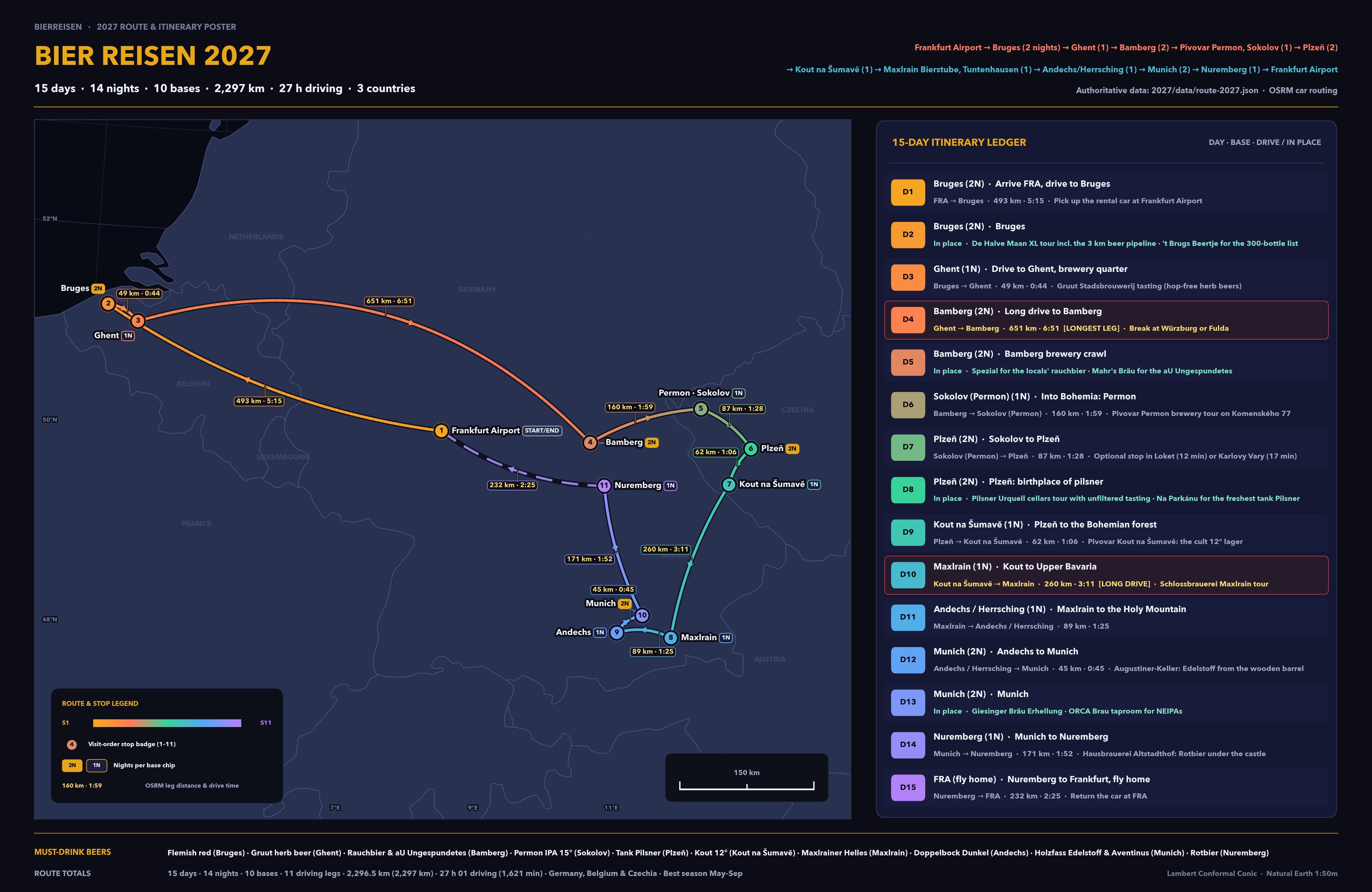
Closed-loop rental-car pilgrimage starting and ending at Frankfurt Airport (FRA): 14 nights across 10 overnight bases in Belgium, Germany, and Czechia, with 11 driving legs (2,296.5 km / 27 h 01) and 4 brewery crawl days, three of them car-free.
All 43 vetted breweries, medieval cellars, monastery taps, and brown cafés across the 10 overnight bases, ranked 1..n per city with what to order at each stop.
🇧🇪 Bruges 2 nights · Stop #2
Historic centre, De Halve Maan, brown bars on the canal.
🍻 Famous for: Flemish red
1
🇧🇪 Bruges · #1 of 6
De Halve Maan
Only active brewery in the historic centre; Brugse Zot, Straffe Hendrik, 3 km beer pipeline, XL rooftop tour.
🍺 Order this: Brugse Zot blond or Straffe Hendrik quadrupel (city signature: Flemish red)
Family brewery eleven kilometres from Bamberg, brewing since 1797 — an unassuming village taproom, Franconian lagers of real precision, and a reputation among beer travellers that runs far beyond the village.
🍺 Order this: Wagner Lagerbier, then the Dunkel, in the taproom beside the brewhouse
Five distinct European brewing cultures in one loop: Flanders wild & herb ales, Franconian smoked & unbunged cellar lagers, Bohemian decoction tank pilsners, Upper Bavarian wheat & monastery bocks, and Nuremberg copper-red Rotbier.
Belgium 7 styles
Style
What to Expect
Typical ABV
Serving Note
Flemish red
Oak-foeder aged red-brown ale; tart red-currant, cherry, balsamic tang balanced by soft caramel malt.
5.0 – 6.5%
Stemmed tulip or goblet at 8–10 °C; blend of young and oak-aged stock (Bourgogne des Flandres, Rodenbach).
Served unfiltered from cool rock-cut vaults and brewpubs in 0.5 L mugs (Altstadthof, Schanzenbräu, Tucher Mautkeller).
📍 What to Order Where — Keyed to All 10 Bases
Quick ordering cheat sheet in itinerary order from Night 1 in Bruges to Night 14 in Nuremberg.
Base 1 · 2N🍺 Flemish red
🇧🇪 Bruges
Bourgogne des Flandres on the canal; pair with Brugse Zot / Straffe Hendrik at De Halve Maan and the 11% house tripel at De Garre.
Base 2 · 1N🍺 gruut (herb beer)
🇧🇪 Ghent
Blond, Amber, Brown, White, and Inferno at Gruut Stadsbrouwerij; follow with Pils 13 at Dok Brewing and house Max at De Dulle Griet.
Base 3 · 2N🍺 Rauchbier
🇩🇪 Bamberg
Oak-barrel Märzen Rauchbier at Schlenkerla, subtler Rauchbier at Spezial, 'aU' Ungespundetes at Mahr's Bräu, Zwergla at Fässla, and Herren Pils at Keesmann.
Base 4 · 1N🍺 Permon IPA 15°
🇨🇿 Pivovar Permon, Sokolov
Permon IPA 15° and dark specials straight from the taps in Pivovar Permon's Komenského 77 restaurant.
Base 5 · 2N🍺 tank Pilsner
🇨🇿 Plzeň
Unfiltered Urquell in the historic cellars, copper-tank Pilsner at U Salzmannů and Na Parkánu, dark lager at Purkmistr, and craft pours at Raven.
Base 6 · 1N🍺 Kout 12°
🇨🇿 Kout na Šumavě
Unpasteurised Kout 12° pale lager at the revived 19th-century brewery in the Šumava foothills.
Base 7 · 1N🍺 Maxlrainer Helles
🇩🇪 Maxlrain Bierstube
Schlossbrauerei Maxlrain Helles, Dunkel, and Weißbier at the castle Bierstube next door.
Base 8 · 1N🍺 Doppelbock
🇩🇪 Andechs / Herrsching
Monastery Doppelbock Dunkel (7.1%) overlooking the Ammersee at Kloster Andechs, and the full range down at Andechser Hof in Herrsching.
Base 9 · 2N🍺 Helles
🇩🇪 Munich
Wooden-barrel Edelstoff at Augustiner-Keller, Erhellung unfiltered Helles at Giesinger Bräu, Aventinus at Schneider Bräuhaus, and NEIPAs at ORCA Brau.
Base 10 · 1N🍺 Rotbier
🇩🇪 Nuremberg
Organic Rotbier at Hausbrauerei Altstadthof under the castle, Schanzenbräu in Gostenhof, Tucher Mautkeller vaults, and Zeltner Bierhaus.
🚗 Drive Times, Itinerary Legs & 11 × 11 OSRM Car Matrix
Every distance and duration below comes directly from OSRM car routing in data/route-2027.json — zero estimates.
2,296.5 km
Exact Route Total (2,297 km rounded)
27 h 01
1,621 Total Driving Minutes
11 legs
11 Drive Days · 4 Car-Free Days
6 h 51
Longest Day (Day 4: Ghent → Bamberg, 650.5 km)
44 – 45 min
Shortest Hops (Bruges→Ghent & Andechs→Munich)
(a) The 11 Itinerary Driving Legs
Day
From → To
Distance (km)
Time (h:mm)
Route Note
Day 1
🇩🇪 Frankfurt am Main Airport → 🇧🇪 Bruges
492.6 km (493)
5:15(5 h 15)
Arrival motorway push west across Germany & Belgium (E40) — swap drivers if jet-lagged.
Day 3
🇧🇪 Bruges → 🇧🇪 Ghent
49.2 km (49)
0:44(44 min)
Short Flemish hop on the E40; arrives in Ghent well before lunch.
Day 4
🇧🇪 Ghent → 🇩🇪 Bamberg
650.5 km (651)
6:51(6 h 51)
LONGEST · 6 h 51 Longest day of the trip (6 h 51) — leave Ghent early, break at Würzburg or Fulda.
Day 6
🇩🇪 Bamberg → 🇨🇿 Pivovar Permon, Sokolov
160.2 km (160)
1:59(1 h 59)
Scenic cross-border run via Bayreuth & Cheb; activate Czech e-vignette before crossing.
Day 7
🇨🇿 Pivovar Permon, Sokolov → 🇨🇿 Plzeň
86.8 km (87)
1:28(1 h 28)
Relaxed Bohemian drive along the Ohře valley; easy detour to Loket or Karlovy Vary.
Day 9
🇨🇿 Plzeň → 🇨🇿 Kout na Šumavě
61.6 km (62)
1:06(1 h 06)
Short drive south-west into the Šumava (Bohemian Forest) foothills.
Day 10
🇨🇿 Kout na Šumavě → 🇩🇪 Maxlrain Bierstube
259.8 km (260)
3:11(3 h 11)
LONG · 3 h 11 Second-longest drive (3 h 11) — crosses back into Bavaria past Regensburg.
Day 11
🇩🇪 Maxlrain Bierstube → 🇩🇪 Andechs / Herrsching
89.2 km (89)
1:25(1 h 25)
Pre-Alpine country roads west across Upper Bavaria to Ammersee.
Day 12
🇩🇪 Andechs / Herrsching → 🇩🇪 Munich
44.5 km (45)
0:45(45 min)
Shortest leg of the trip (45 min) straight into Munich.
Day 14
🇩🇪 Munich → 🇩🇪 Nuremberg
170.6 km (171)
1:52(1 h 52)
North on the A9 from Upper Bavaria into Franconian Rotbier country.
Day 15
🇩🇪 Nuremberg → 🇩🇪 Frankfurt am Main Airport
231.5 km (232)
2:25(2 h 25)
Final A3 motorway return to Frankfurt Airport — leave buffer for traffic, fuel & car drop-off.
15 Days
Closed Loop: FRA → 10 Bases → FRA (11 legs)
2,296.5 km (2,297 km)
27:01 (1,621 min)
3 countries · 14 nights · 4 in-place crawl days
(b) Full 11 × 11 Car Distance & Duration Matrix
Upper triangle directly from matrix.pairs (55 OSRM pairs), mirrored symmetrically across the — diagonal. Gold-outlined cells mark consecutive stops driven on the itinerary. Note: in symmetric pair lookup fra|nuremberg is 230.7 km / 2:27, whereas the directed Day 15 return leg nuremberg → fra is 231.5 km / 2:25 due to motorway interchange geometry.
From \ To
FRA
Bruges
Ghent
Bamberg
Permon (Sokolov)
Plzeň
Kout na Šumavě
Maxlrain
Andechs
Munich
Nuremberg
FRA
—
493 km5:15
453 km4:54
213 km2:24
375 km4:07
425 km4:13
394 km4:21
441 km4:30
439 km4:27
402 km4:04
231 km2:27
Bruges
493 km5:15
—
49 km0:44
682 km7:17
844 km9:01
894 km9:06
863 km9:14
910 km9:23
869 km9:10
871 km8:57
699 km7:20
Ghent
453 km4:54
49 km0:44
—
651 km6:51
813 km8:35
863 km8:41
832 km8:48
879 km8:57
838 km8:45
840 km8:31
668 km6:54
Bamberg
213 km2:24
682 km7:17
651 km6:51
—
160 km1:59
255 km2:41
224 km2:48
271 km2:57
269 km2:54
232 km2:31
61 km0:54
Permon (Sokolov)
375 km4:07
844 km9:01
813 km8:35
160 km1:59
—
87 km1:28
112 km1:51
322 km3:32
320 km3:29
283 km3:06
198 km2:10
Plzeň
425 km4:13
894 km9:06
863 km8:41
255 km2:41
87 km1:28
—
62 km1:06
328 km3:30
326 km3:27
289 km3:04
204 km2:08
Kout na Šumavě
394 km4:21
863 km9:14
832 km8:48
224 km2:48
112 km1:51
62 km1:06
—
260 km3:11
258 km3:07
221 km2:45
174 km2:14
Maxlrain
441 km4:30
910 km9:23
879 km8:57
271 km2:57
322 km3:32
328 km3:30
260 km3:11
—
89 km1:25
50 km0:50
210 km2:18
Andechs
439 km4:27
869 km9:10
838 km8:45
269 km2:54
320 km3:29
326 km3:27
258 km3:07
89 km1:25
—
45 km0:45
208 km2:16
Munich
402 km4:04
871 km8:57
840 km8:31
232 km2:31
283 km3:06
289 km3:04
221 km2:45
50 km0:50
45 km0:45
—
171 km1:52
Nuremberg
231 km2:27
699 km7:20
668 km6:54
61 km0:54
198 km2:10
204 km2:08
174 km2:14
210 km2:18
208 km2:16
171 km1:52
—
(c) Totals & Practical Road Notes
🇨🇿 Czech Motorway Vignette Required
Passenger cars on Czech motorways require an official electronic vignette (edalnice.cz) registered to the rental license plate — purchase it before crossing near Cheb on Day 6 to cover the Bohemian stretch (Days 6–10), and confirm cross-border permission for Belgium and Czechia at the FRA rental desk.
🇧🇪 Belgium Has No Motorway Toll
Belgian motorways (E40 to Bruges and Ghent) are completely toll-free for passenger cars. Watch out instead for Ghent's inner Low Emission Zone (LEZ): register foreign German rental plates online beforehand or park at edge-of-centre garages.
🇩🇪 German Autobahn & A-Road Alternatives
German Autobahns have no passenger-car tolls, though summer Baustellen (roadworks) slow sections of the A3 (Frankfurt–Würzburg–Nuremberg) and A9 (Munich–Nuremberg). On shorter hops (Bamberg–Bayreuth–Cheb, Maxlrain–Andechs), scenic federal B-roads offer relaxed country driving.
⏱️ Tackling the 6 h 51 Day (Ghent → Bamberg)
Day 4 (650.5 km / 6 h 51) is by far the longest leg, trading West Flanders for Upper Franconia in one push. Depart Ghent early to clear the Brussels/Cologne rings smoothly, split the drive with lunch in Würzburg or Fulda, then park for two nights and reward yourself with oak-barrel Rauchbier at Schlenkerla.
16 optional side trips measured from their nearest overnight base, followed by six essential planning rules for a smooth pilgrimage.
🇧🇪 From Bruges 2 side trips
Stop #2 · 2 nights
Westvleteren (In de Vrede)
72 km · 1 h 06 (1:06)
Abbey café opposite Sint-Sixtus pouring Trappist Westvleteren 12, 8, and Blond on the terrace without needing a crate reservation.
Roeselare (Rodenbach)
38 km · 35 min (0:35)
Cathedral-like foeder halls where Flemish red-brown ales age for years in towering oak vats.
🇧🇪 From Ghent 1 side trip
Stop #3 · 1 night
Antwerp
61 km · 51 min (0:51)
Flemish beer port home to De Koninck city brewery, historic brown bars, and legendary vintage-bottle café Kulminator.
🇩🇪 From Bamberg 4 side trips
Stop #4 · 2 nights
Memmelsdorf — Drei Kronen
8 km · 13 min (0:13)
Eight kilometres east: brewery, Gasthof and hotel in one building, hand-brewed Franconian beer and a full kitchen.
Merkendorf — Brauerei Wagner
12 km · 19 min (0:19)
Eleven kilometres north: a family brewery running since 1797, with a village taproom and lagers that beer travellers cross the region for.
Aufseß (four-brewery loop)
29 km · 34 min (0:34)
Walkable Franconian Switzerland trail linking four village family breweries (Reichold, Rothenbach, Stadter, Kathi-Bräu).
Forchheim
28 km · 28 min (0:28)
Forested Kellerwald hillside lined with traditional rock-cut Franconian beer cellars under chestnut trees.
🇨🇿 From Pivovar Permon, Sokolov 2 side trips
Stop #5 · 1 night
Loket
12 km · 12 min (0:12)
Dramatic medieval castle town wrapped inside a tight horseshoe bend of the Ohře River — effortless stop en route to Plzeň.
Karlovy Vary
20 km · 17 min (0:17)
Grand Bohemian spa town of riverside colonnades and steaming mineral springs just east of Sokolov.
🇨🇿 From Plzeň 2 side trips
Stop #6 · 2 nights
Žatec (hop capital)
86 km · 1 h 29 (1:29)
Historic Saaz hop capital with the Hop Museum, Temple of Hops, and local brews yards from the bines.
Chodová Planá (Chodovar beer spa)
67 km · 52 min (0:52)
Centuries-old granite beer caves with an underground restaurant and traditional warm beer-bath spa.
🇨🇿 From Kout na Šumavě 1 side trip
Stop #7 · 1 night
Regensburg
102 km · 1 h 32 (1:32)
UNESCO medieval Danube city with time-capsule Kneitinger beer hall and Spitalbrauerei by the Stone Bridge (natural Day 10 break).
🇩🇪 From Maxlrain Bierstube 1 side trip
Stop #8 · 1 night
Wendelstein
24 km · 20 min (0:20)
Bavarian pre-Alps peak reached by historic cog railway or cable car for clear-day Alpine panoramas.
🇩🇪 From Andechs / Herrsching 1 side trip
Stop #9 · 1 night
Herrsching (Ammersee)
5 km · 8 min (0:08)
Lakeside overnight base below Kloster Andechs — walk or ride the local bus up the Holy Mountain so the car stays parked.
🇩🇪 From Munich 1 side trip
Stop #10 · 2 nights
Freising (Weihenstephan)
41 km · 39 min (0:39)
Hilltop Bavarian State Brewery Weihenstephan north of Munich, revered for benchmark Hefeweizen, Vitus, and Korbinian.
🇩🇪 From Nuremberg 1 side trip
Stop #11 · 1 night
Bamberg
61 km · 54 min (0:54)
Quick run north up the Regnitz valley if you want one more oak-barrel Rauchbier or cellar Ungespundetes.
🧭 Six Trip-Level Tips Before You Go
1. Book Pilsner Urquell & Purkmistr Ahead
Reserve English-language Pilsner Urquell cellar tours (for the unfiltered oak-barrel pour) and Purkmistr beer-spa slots weeks ahead, plus De Halve Maan's XL rooftop/pipeline tour in Bruges.
2. Watch Monday Closures (Ruhetag)
Small family breweries in Bamberg, Franconian villages, rural Bohemia, and Upper Bavaria frequently close on Mondays and/or Tuesdays. Verify weekly taproom hours so a key brewery isn't shuttered.
3. Carry Cash in Franconia & Country Inns
Traditional Bamberg Schwemme tap windows, hillside beer cellars, and village inns often take cash only. Carry small Euro bills in Germany and Czech koruna (CZK) in Sokolov and Kout na Šumavě.
4. Strict Driving & Drinking Rules (0.0% in Czechia)
Czechia enforces zero tolerance (0.0% BAC) behind the wheel, and Germany and Belgium enforce strict drink-driving limits as well. Finish each day's drive first, check in, and visit every brewery on foot or local transit (e.g. Herrsching ↔ Kloster Andechs).
5. Best Season: May – September
Late spring through early autumn opens Bamberg's Greifenklau terrace, Forchheim's Kellerwald, Munich's chestnut-shaded Augustiner-Keller, Ammersee panoramas at Andechs, and Šumava forest trails.
6. Bottle Crate Space & Airport Return
Keep a sturdy crate in the boot for De Hopduvel (Ghent), Kout 12°, and Franconian bottles — pack bubble sleeves for checked luggage before returning the rental car at FRA on Day 15.