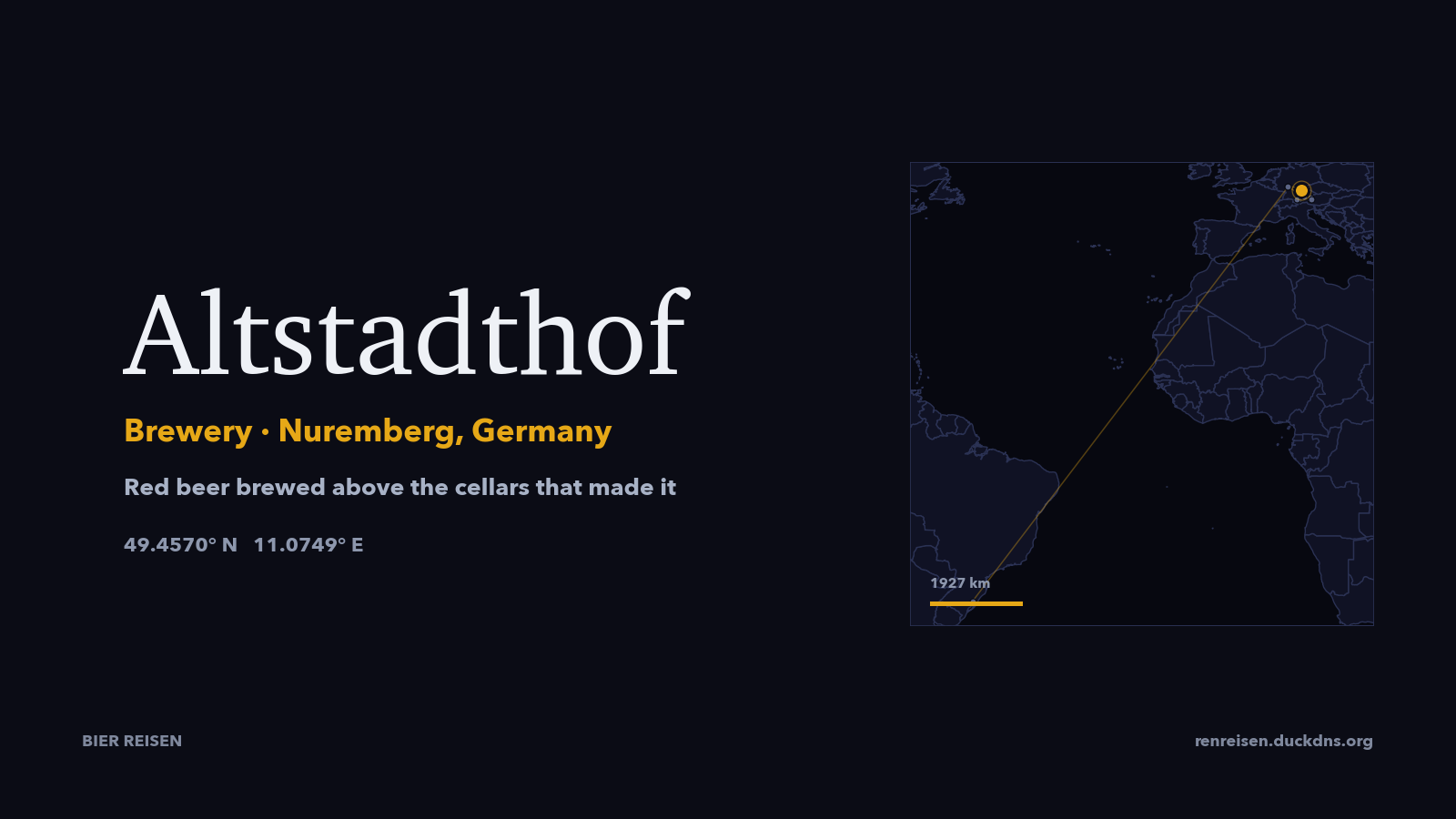
The cellar under the kettle
In 1303 the council of Nuremberg ruled that only barley malt could be used for brewing, a good two hundred years before the Bavarian Reinheitsgebot. In 1380 it went further: anyone who wanted to brew and sell beer had to have his own cellar. The sandstone under the town was cut into galleries, and the galleries went down four storeys in places. The council inspected the works, and a brewer whose pillars did not stand over one another was punished.
That was not decoration. Rotbier was fermented cold, in an age when almost every other beer was top-fermented, and cold meant underground. The cellars hold a constant eight to twelve degrees, which is why the beer could be stored through the summer and why the trade could grow. Twenty-five thousand square metres of them lie under the old town. In winter ice was packed into cooling domes cut between the floors, and it lasted into the summer.
The style went under in the nineteenth century, when paler beers were cheaper to make. The house on Bergstraße, the old Rotes Brauhaus, stood empty of brewing for decades. Since 1984 it has brewed again under the name Altstadthof, and the cellars next door, which had been used as air-raid shelters in the war, are open to visitors. The tour of them leaves from the brewery shop several times a day.
Copper, wood, and a red malt
The kit is deliberately old. Brewing happens in copper kettles, fermentation in wooden vats, and the malt comes from Neumarkter Lammsbräu, the hops from Eckert & Friedrich in Eckental — both organic. The brewery says it was the first in Germany to brew exclusively with organic raw materials when it reopened in 1984, and it has kept the claim since. Only organic cone hops go in, which is more work than extract and shows in the smell of the brewhouse.
Rotbier is 5.2% with 13.5% original wort: copper-coloured, soft on the tongue, with a mild hop finish and a slight sweetness that comes from the red malt. Around it the brewery keeps a Kellerbier at 4.8%, a black beer at 5.1%, a red wheat beer brewed with half red malt, and a spiced winter beer at 5.6%. The red malt is dried harder than pale malt, which is where the colour and the toasted note come from.
The same red malt goes into the whisky. The distillery started in 2005 and bottles AYRER's single malt, named after the Ayrer family who owned the estate until 1568. The brewery calls it the first organic single malt in Germany. It ages on site, in small casks, some of them finished in sherry or port wood. Private casks can be bought and left to mature on site, which is a slow way to furnish a cellar.
Three rooms and a tour
There are three places to sit: the Bräustüberl, small and plain, with the brewery's copper visible through the door; the Restaurant Bühne; and the Sommergarten, which opens when the weather allows. At Bergstraße 21 the Schmelztiegel opens at seven in the evening for beer, music and parties in a vaulted cellar. Between the three there is room for a quick glass at midday and a long dinner after the tour.
The kitchen puts the beer into the food. Schäufele comes in a red beer sauce with a dumpling and sauerkraut; Blaue Zipfel are six bratwursts simmered in red beer vinegar with onions; the onion soup is laced with red beer; the schnitzel is breaded in crushed malt. For dessert there is a Beeramisu, which is exactly what it sounds like. The vegetables come from the Knoblauchsland, the market-garden belt north of the city.
The tour is the reason to come late in the day. Rotes Bier in tiefen Kellern starts at the brewery shop at 17:30, runs about an hour through the rock passages, and ends with a small tasting and a look into the whisky store. On Friday and Saturday there is a second start at 17:45. The route runs at a constant eight to twelve degrees, so a jacket is sensible even in summer.