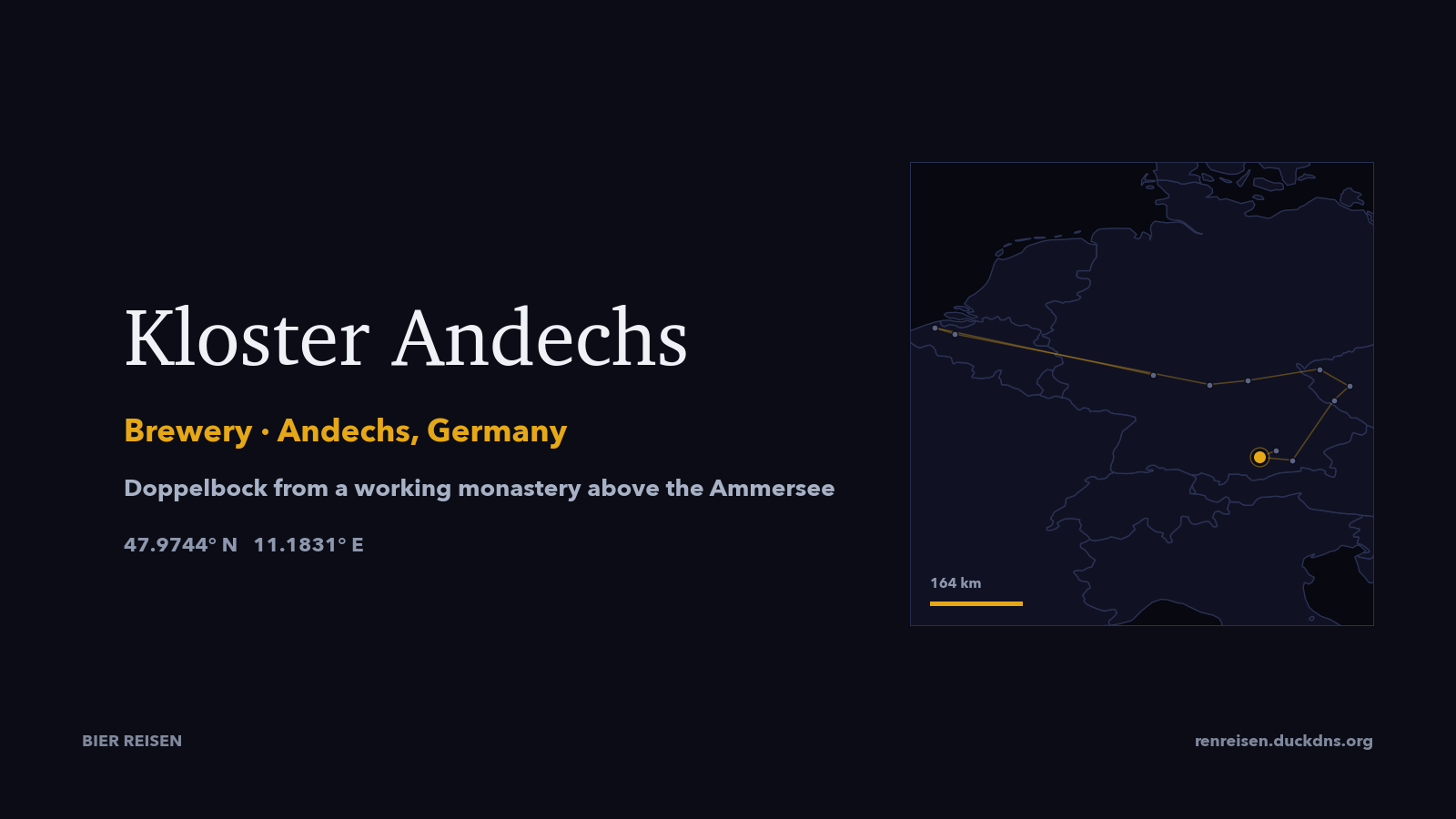
The holy mountain
On 26 May 1388 a hoard of relics was found under the altar of the ruined castle chapel, and the pilgrimage began almost at once. The Three Hosts came back in 1394; the church that holds them was built between 1423 and 1427, and Johann Baptist Zimmermann gave it its rococo interior between 1751 and 1755. The site had been the seat of the Counts of Andechs, a family that died out in 1248.
In 1455 Duke Albrecht III turned the canonry into a Benedictine monastery. Fire destroyed almost everything in 1669, the brewery and bakery included, and the rebuild was finished by 1674. Secularisation dissolved the house in 1803. Ludwig I bought it in 1846 for 65,000 gulden and gave the buildings and estates to St. Bonifaz in 1850, the abbey he had founded in Munich.
The monastery is a priory of St. Bonifaz and sits in the diocese of Augsburg, which surprises people who assume Bavaria is one ecclesiastical block. The brewery is its largest business and pays for the abbey's scholarly, cultural and social work. Carl Orff is buried in the Schmerzhafte Kapelle, a side chapel off the nave, which is either incongruous or exactly right.
The brewery
Brewing here is documented from 1455. Today it is the largest of the few German monastery breweries still run by a living order and independent of any group, and everything is brewed and bottled on the site. Output is over 100,000 hectolitres a year, most of it sold across Germany and exported; only a small share is drunk on the hill, which is why the beer turns up in Munich bars at all.
Doppelbock Dunkel, 7.1 per cent and 18.8 degrees Plato, is the beer to order: dark bread, dried fruit, a finish drier than the nose promises. It is brewed all year, which is unusual for a German monastery brewery and the reason it travels. Spezial Hell, Vollbier Hell, Bergbock Hell, Export Dunkel, Weißbier Hell and Dunkel, and a Weizenbock in season complete the range.
The tanks are not in the monastery. The brewery stands at the foot of the hill, built in 1972, with the barrel and bottle cellar added in 1974, a new brewhouse in 1983 and a thorough renewal in 2007. So the walk up is to the church, the terrace and the Bräustüberl; the production side sits below, out of sight, sending beer up by lorry.
The Bräustüberl
It is a self-service room: take a tray, queue at the counter, pay, then find a table in the vault or on the terrace. Cold plates, cheese, sausages, a few warm dishes, and bread that is better than it needs to be. You may bring your own Brotzeit, as at any Bavarian beer garden, as long as the beer comes from the house. The room is plain, the queue moves, and the view does the decorating.
The walk up from Herrsching is about five kilometres along the Kienbach, through woods, with the monastery appearing above the trees near the end. It takes an hour at an easy pace. Bus 951 does the same trip from the station in ten minutes, and the S8 from Munich takes about fifty, so the whole thing is a half-day rather than an expedition.
Below the church, the Klostergasthof is the sit-down restaurant and the place to sleep if you want the hill at dawn. The Bräustüberl is the more useful room, and the terrace is the reason most people come. Weekends are crowded, weekday mornings are not, and the church is worth ten minutes before the beer. Book the Klostergasthof well ahead in summer.