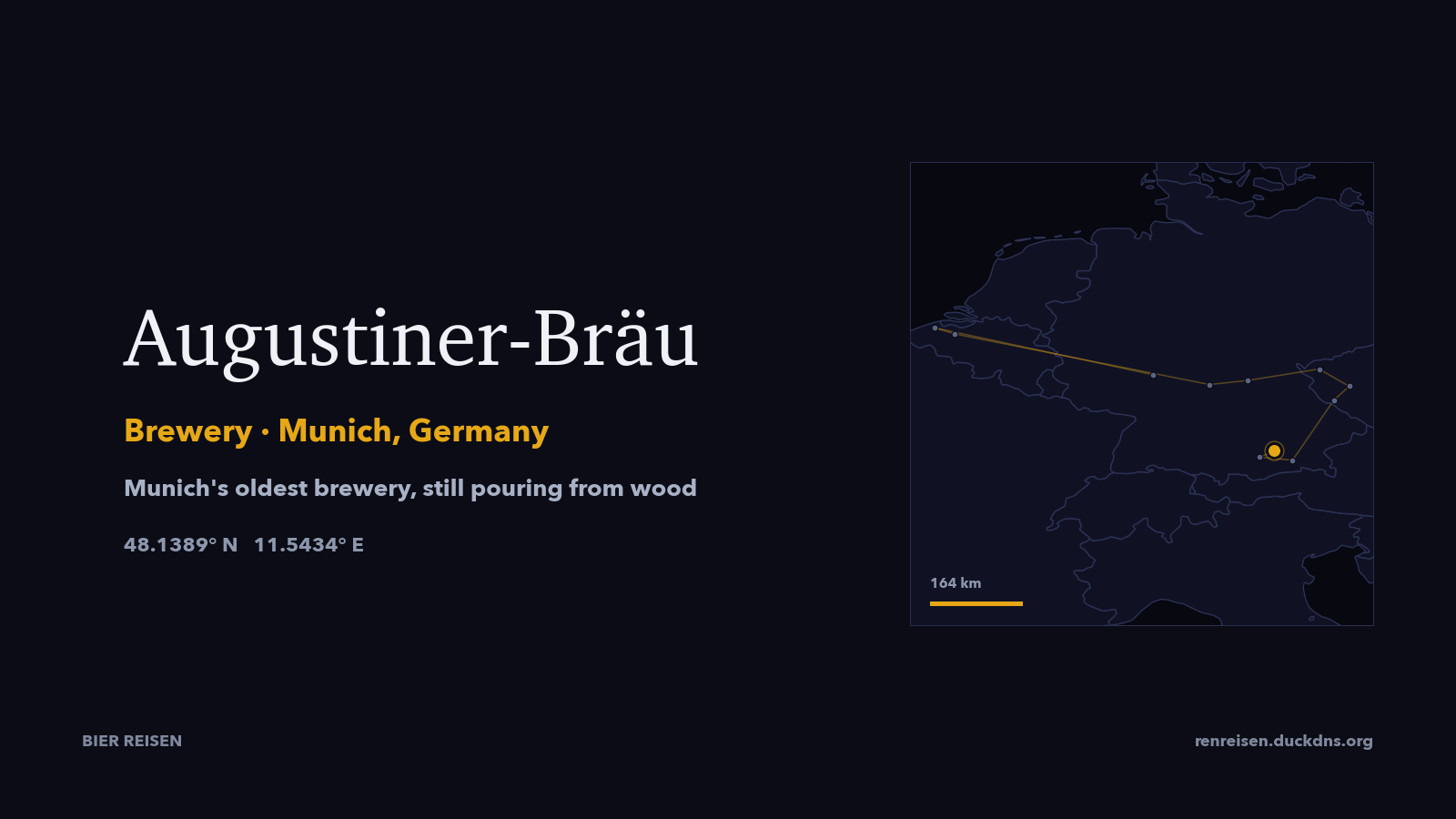
From cloister to Landsberger Straße
The Augustinian hermits settled outside the city walls in 1294 and moved inside around 1320. Their brewery is named in 1328, the year a note places the bakers' brotherhood in the monastery's brewhouse after the fire of 1327, and that is the date the company uses. The first unambiguous record of brewing on the site is 1411. Either way it is the oldest brewery in Munich still working.
Secularisation dissolved the monastery in 1803. The brewing right passed to two men, Gröber and Lankes, who were given a brewhouse in Neuhauser Straße in 1817 after a long dispute over the monastery lease. In March 1829 the authorities handed the right to Anton and Therese Wagner, a brewing family from Attaching near Freising. Anton died in the 1840s; Therese took over, bought a lager cellar on Landsberger Straße in 1857, and ran the business until her son Josef inherited it in 1858.
Josef moved the whole brewery to Landsberger Straße in 1883 and brewed there for the first time in 1884; his initials, JW, have been on the label ever since. The plant was 60 per cent destroyed by bombing in 1945 and rebuilt. Edith Haberland-Wagner, the last of the family to carry the name, died in 1996 and left her majority share to a charitable foundation, on condition that the brewery stays on Landsberger Straße and keeps its own floor maltings.
The beer
Nine sorts, mostly lager. Lagerbier Hell at 5.2 per cent is the volume beer, green label, known in Munich simply as the Gustl. Edelstoff at 5.6 per cent arrived in 1925 as the stronger export version and is the one to look for on tap from wood: rounder, a little sweeter, and the reason people order a second before finishing the first.
The rest of the range: Dunkel and Pils at 5.6, Weißbier at 5.4 since 1986, a Heller Bock at 7.5 in May and June, Maximator at 7.5 through Lent, and the Oktoberfestbier at 6.4, usually the strongest beer on the Wiesn. Water comes from two wells under the city, 190 and 230 metres down. The malt comes from sixteen floor maltings in the cellars, each forty metres long and ten wide.
The stubbornness is the point. Augustiner barely advertises, kept the euro bottle when the others changed, and still delivers beer in wooden barrels. At the Oktoberfest it is the only brewery that taps exclusively from wood, as it has since 1987. The beer tastes of malt rather than hops, finishes dry, and is the reason Munich people will argue about a brewery for an hour and then order the same thing.
Where to drink it
The Bräustuben at Landsberger Straße 19 is the brewery tap, a canteen-sized room beside the plant. Long tables, waitresses carrying eight Maß at a time, meatloaf with a fried egg, and a mix of brewery workers and families at lunch. It is the least theatrical of the Augustiner houses and the one closest to the source, which is not the same thing as the prettiest.
The Augustiner-Keller at Arnulfstraße 52 is the other pole. It appears on the city map in 1812 as a beer store, was bought by Josef Wagner in 1862, took its present name in 1880, and was laid out as a garden with 5,000 seats in 1896. Chestnuts, gravel, long benches, and a cellar that still sends beer up in wooden barrels. In summer the garden is the whole point, and the waitresses work the rows as if on a shift.
The Stammhaus at Neuhauser Straße 27 is the city-centre room, rebuilt as a beer palace by Emanuel von Seidl in 1896 and still the busiest address between Marienplatz and the Hauptbahnhof. Around 190 Munich pubs pour Augustiner, and the brewery runs more than sixty of them itself. That is how a brewery without advertising stays visible: it owns the rooms people already use.