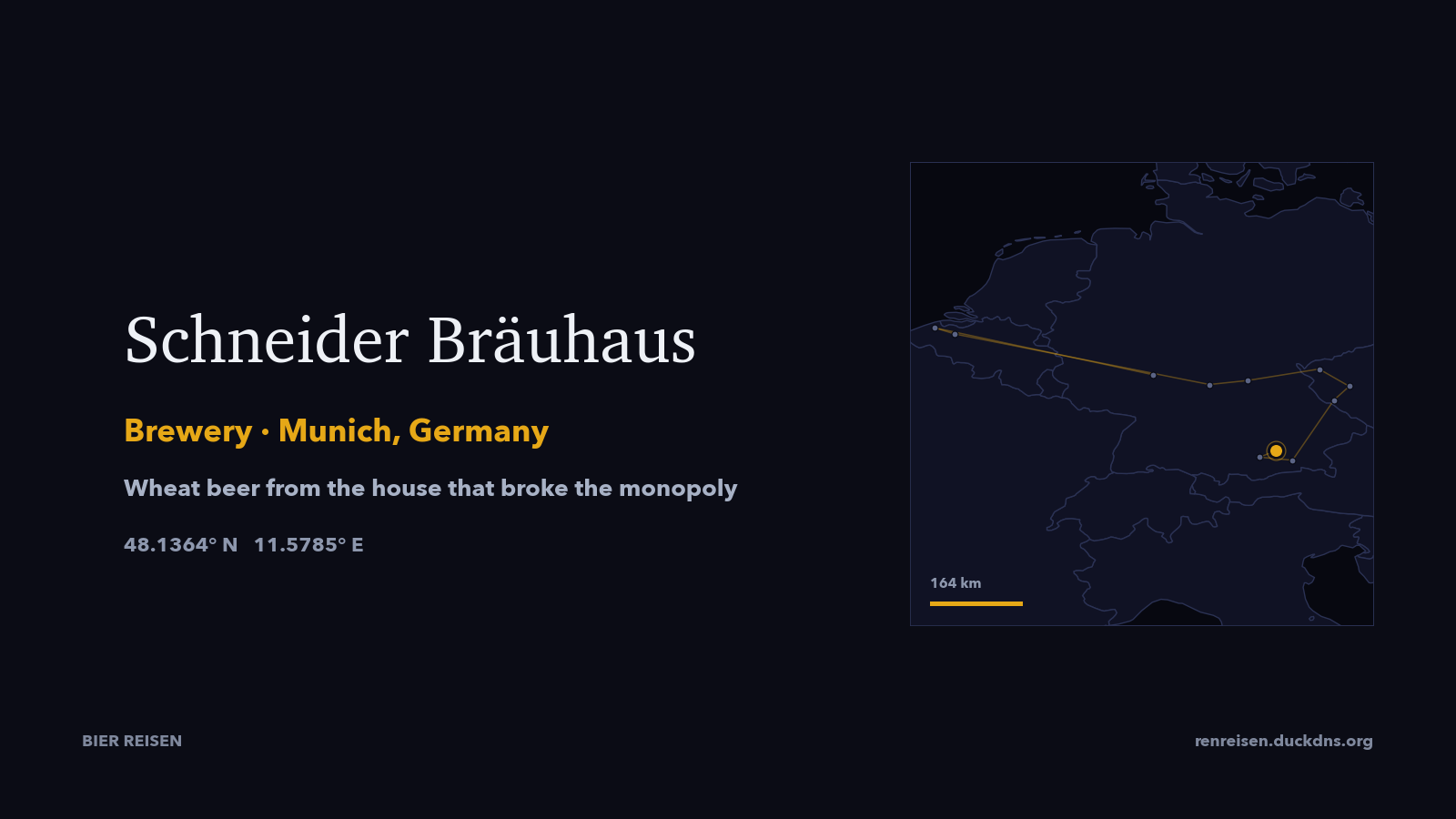
The end of a monopoly
For two centuries wheat beer was a Wittelsbach privilege, granted to one family at a time and enforced across Bavaria. Karl Theodor lifted the general monopoly in 1792 but kept the right to grant it, and the Hofbräuhaus held that right in Munich. By 1872 the court brewery was considering dropping wheat beer altogether, because lager sold better and the tanks were needed for it.
Georg Schneider, the Hofbräuhaus tenant, negotiated the Weissbierregal with Ludwig II and became the first commoner to hold it. He bought the abandoned Maderbräu premises at Tal 7 in the same year and began brewing with his son Georg II. The company dates its founding to 1872, and the recipe for what is now Tap 7 has not changed since, which is either conservatism or confidence.
Mathilde Schneider ran the brewery from 1905 to 1924 and launched Aventinus in 1907, the first wheat doppelbock in Bavaria. The family bought the Kelheim brewery in 1928. After the Munich plant was destroyed by bombing in 1944, production moved to Kelheim in 1946, and the house on Tal became a restaurant. Georg VII has run the company since 2025.
The house on Tal
The building is not medieval, whatever the name suggests. The old Maderbräu and Bachlbräu houses were demolished in 1901, and the construction firm Heilmann & Littmann put up the present five-storey block in 1902 and 1903. The first floor, originally flats, was folded into the restaurant during the renovation of 1987 to 1993, which is why the room now has two distinct levels.
The ground-floor Schwemme is small, nine metres by nine, with a vaulted ceiling and windows onto the Tal. Upstairs is lighter and quieter, and better for a long dinner. The menu is Bavarian cooking built around wheat beer: Obatzda with a pretzel, sausages, roast pork with dumplings, and a few dishes that exist mainly to be dipped into the beer.
It is a city restaurant with a brewery's history, not a museum. Office lunches at noon, tourists in the afternoon, families in the evening; the staff know the difference between Tap 7 and Aventinus and will steer you if you ask. There are three Schneider houses: this one, Berg am Laim, and the brewery tap in Kelheim, which is the only one with the tanks next door.
The beer
Tap 7 at 5.4 per cent is the original: open fermentation, a second fermentation in the bottle, no filtration, 12.8 degrees Plato. It arrives cloudy and needs the usual treatment, two-thirds into the glass, a swirl of the bottle, then the rest. Clove, banana, a dry finish, and a texture that is thinner than the colour suggests, which is why it goes down faster than it should.
Aventinus at 8.2 per cent is the oldest wheat doppelbock in Bavaria, brewed since 1907 and named after Johannes Aventinus, the court historian who wrote the first proper history of the duchy. Dark, plummy, almost oily, and served in a tall glass because a Maß would be reckless. The Eisbock is the same beer partly frozen and concentrated to around 12 per cent, and it ends evenings.
The wider range is worth knowing: Tap 1 Helle Weisse, Tap 5 Hopfenweisse made with Brooklyn Brewery, Tap 4 Festweisse, and a Helles under the Landbrauerei label. All of it is brewed in Kelheim now, so a visit here is a meal and a history lesson rather than a brewery tour. The taps are the point, and there are more of them than most bars can pour.