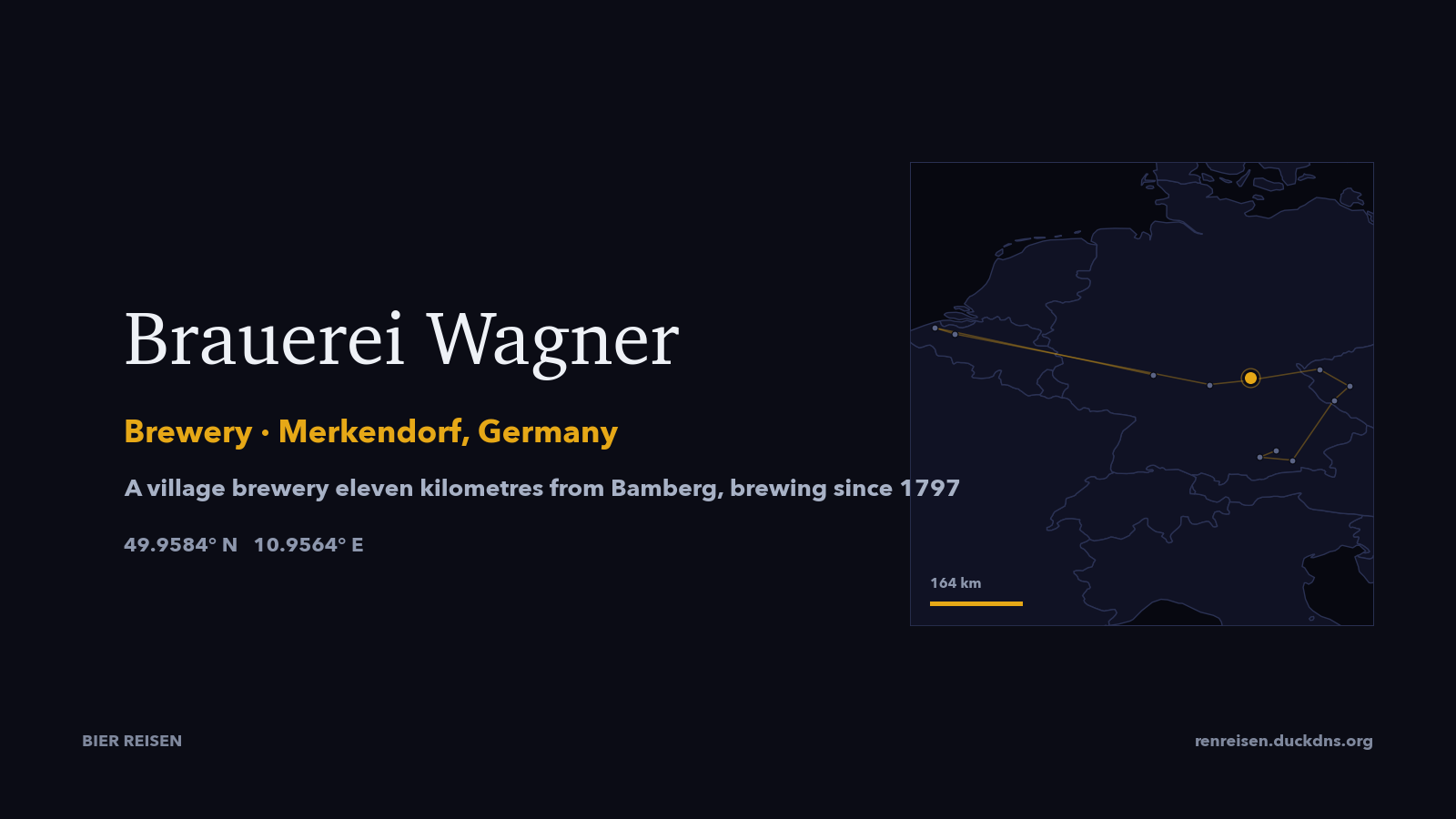
The village
Merkendorf belongs to Memmelsdorf and sits north-east of Bamberg, close enough that people drive out for lunch and back for the afternoon. The village has two breweries: Wagner on the Pointstraße and Hummel on the Lindenstraße, the second brewing on a site that goes back to 1556. Two breweries in a village this size is not unusual in Franconia, but it is worth pausing over: the competition never forced either of them out.
The Gasthaus is a working room: a dining room, a bar, a daily card and a brewery behind the wall. Nothing is staged for visitors, and the awards the brewery has won hang on the website rather than on the wall. The family has run it since 1919; Günther and Rainer Wagner are the names on the company now, and the kitchen still cooks for the village.
The range, brewed dry
The core beer is a Lagerbier Ungespunden, 12.7% original wort and 5.3%, a speciality the brewery says exists only in Bamberg and its district: low carbonation, firm malt, a late hop. It is the beer to order first, and the one that shows the house style — dry, precise, and less soft than the city's smoke beers. It is also what fills the room at lunch, ordered by people who never look at the card.
Around it: a Pils at 12.1% and 4.9%, the brewery's best seller; a Märzen at 13.2% and 5.4%; a Kupferstich Rotbier at 12.1% and 4.9%, red from a special malt mix; a Festbier at 13.5% and 5.7%; a Kellerbier brewed for the village's 850th anniversary; and two bocks at 16.8% and 7.5%, one pale and one dark, released in mid-November.
The odd one out is Richard Wagner Dunkel, a dark lager at 13.2% and 5.5%, first brewed for the 75th birthday of the senior boss and kept on because the village would not let it go. The label carries the name of the man it was brewed for, which is a very Franconian way of naming a beer: not a style, not an adjective, just the person.
The table and the garden
The kitchen is Franconian and unpretentious: Braten with Klöße from Wednesday to Sunday, Brotzeiten all day, a daily card that runs to Leberkäse and Bratkartoffeln on Wednesday and fish on Friday. On Sundays the roast is served until two, then a short evening card takes over. The portions are large and the prices are village prices. Nobody comes for a tasting menu; they come because the beer is good and the plate is full.
Behind the house there is a beer garden under trees, away from the road, with a playground beside it and space for bicycles. Twice a year the village takes over: Kirchweih on the second Sunday after Assumption in August, and the Bockbieranstich on the Friday before Buß- und Bettag in November. Both dates are published by the brewery, and both fill the garden.