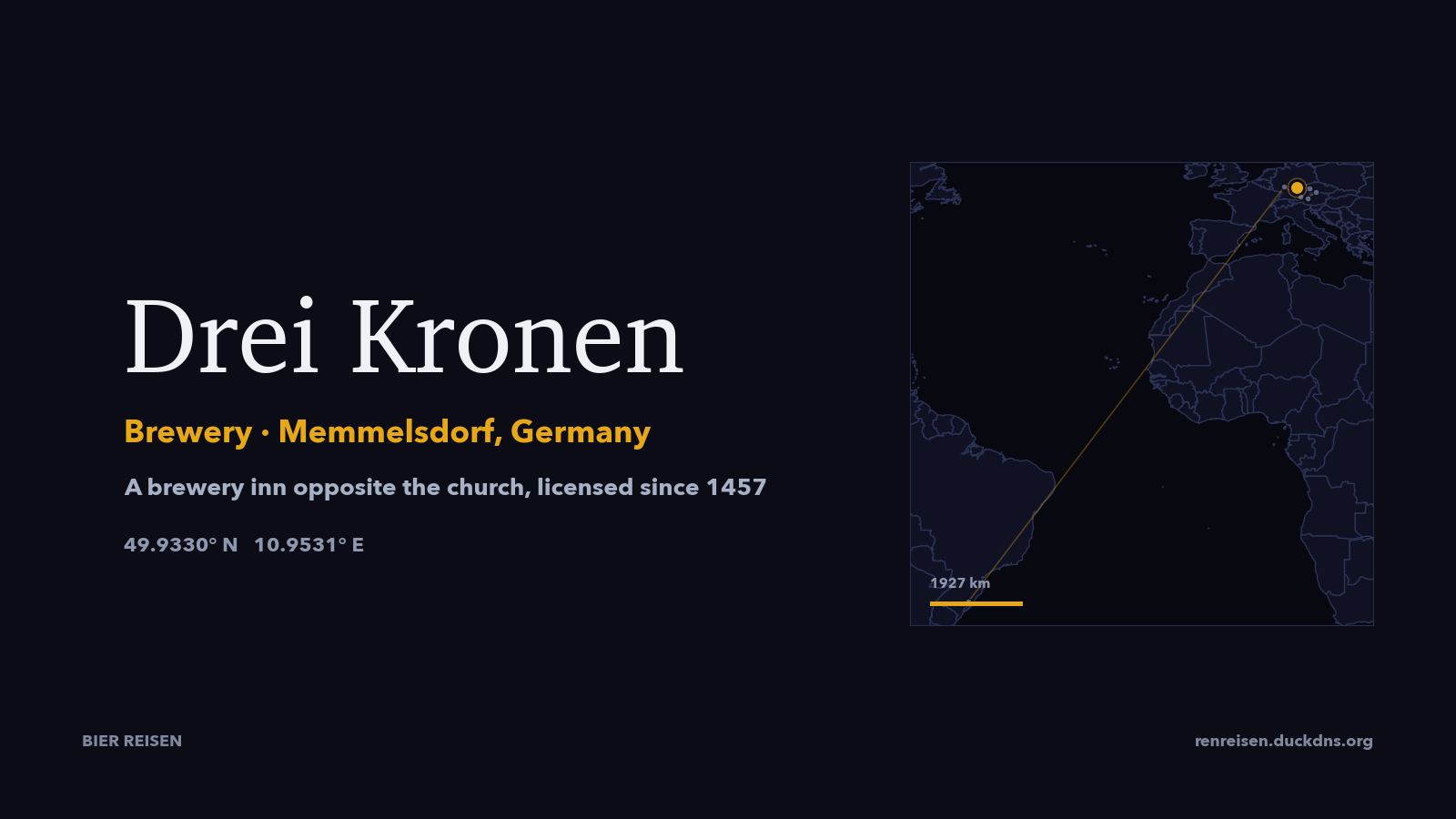
Five centuries opposite the church
The property is first recorded in 1457, when a tailor bought it, and it has carried a licence to sell beer for most of the time since. The present building went up in 1748 as the Vogtei of Memmelsdorf, the office of the prince-bishopric's bailiff, which is why it is larger and more formal than the farmhouses around it. From the street you see the church first, then the house, with its mansard roof and the ice tower behind.
Behind the house stands the ice tower, built around 1880 in brick Gothic, with an open gallery near the top. Ice was cut from the ponds in winter and packed inside, then used through the summer to keep the beer cool before refrigeration reached the village. It is a listed building now, and so is the main house, both under the Bavarian monument law, and the brewery tour goes up the tower.
The name comes from the Three Kings, not from three crowns on a shield. The Straub family has run the house for four generations; since March 2016 the kettles belong to Isabella Mereien, née Straub, and Markus Mereien, who met at the master brewers' school in Munich in 2007. She grew up in the building. He did not. Three crowns hang over the door, and the brewhouse still keeps a coolship.
The brewhouse
In 2004 the old brewhouse was taken out and replaced. The family chose a classical, manually worked kit from Kaspar Schulz in Bamberg and insisted on keeping the coolship, the shallow open vessel where the wort cools overnight and unwanted aromas leave with the steam. The first brew ran on 1 December 2004, a pale beer named Balthasar after one of the three kings.
The range is wide for a village brewery. There is the 1457 Lager, the pale Helle Lotte, the Stöffla, a wheat beer called Orgelweiße, a Böckla, a Kerwabier for the church fair, a Fastenbier in Lent, and experiments: a coolship IPA called Nessie and a pink beer brewed by women for women. Most of it is sold in the house and within a few kilometres of it.
The Stöffla is the beer with the medal: gold at the European Beer Star in 2003, in the smoked beer class, won with the old brewhouse. It is lightly smoky rather than blunt, with aroma hops from Spalt in the nose, and it is the reason people who know Franconia know this village. The Orgelweiße has a story too: the first brew in the early 1990s paid for the new organ in the church across the road.
Eating and sleeping
There are four rooms to eat in: the Gute Stube, the Kachelofenzimmer with its tiled stove, the Terrassenzimmer, and the beer garden in summer. The kitchen calls itself Franconian-modern and means it: roasts from the grandmother's cookbook, meat from the Franconian Jura, vegetables from the region, and the house beer in the sauces. Vegetarian and vegan dishes are on the card, which is not usual here.
Upstairs are hotel rooms, most of them former servants' chambers and, from 1973, the old malt floor. They are ordinary rooms in a building that creaks, and the people who run them will tell you which window looks over the church. Monday is the Ruhetag; the kitchen stops at nine from Tuesday to Thursday, half past nine on Friday and Saturday, half past seven on Sunday.