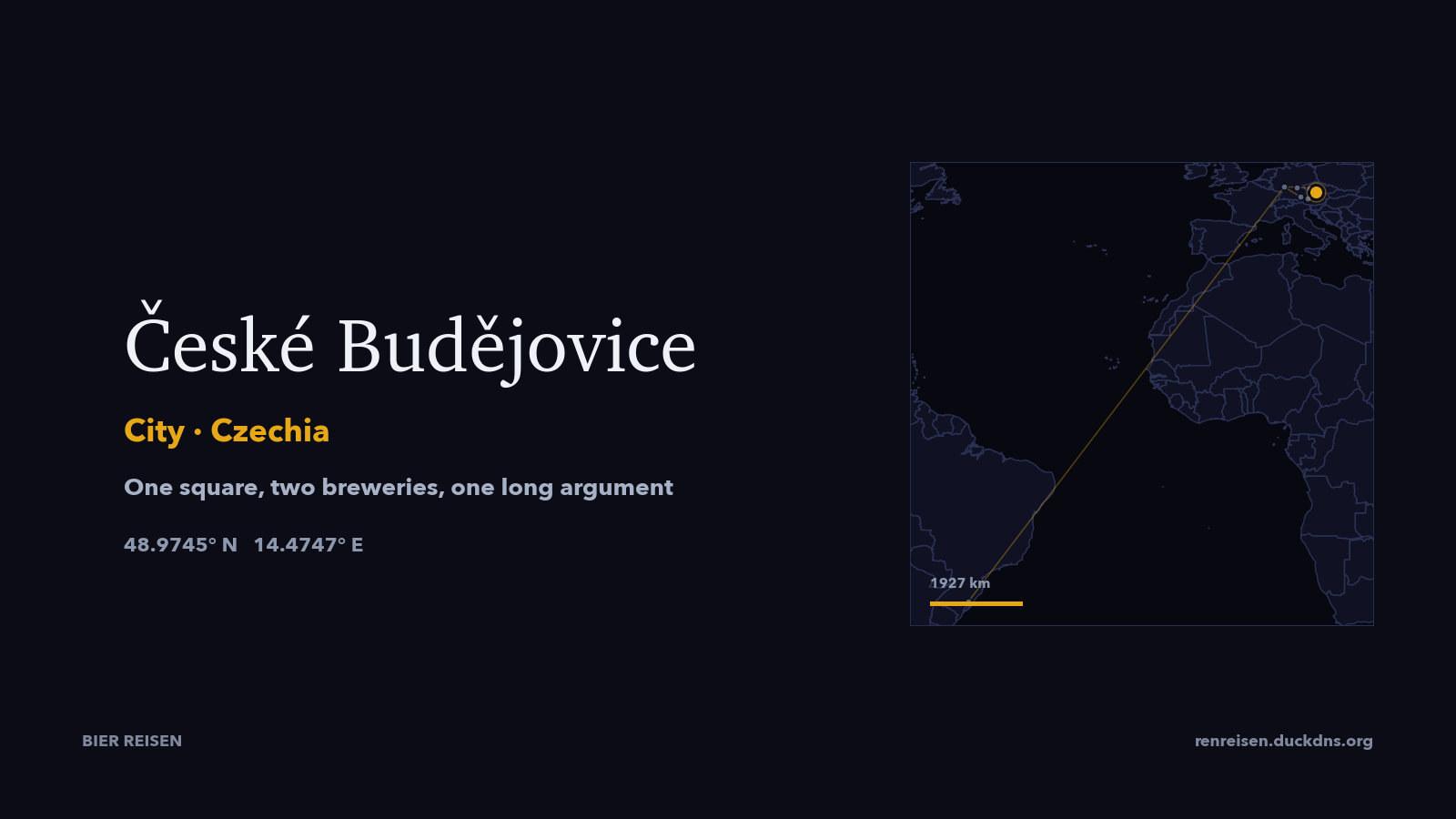
A square with a town attached
Přemysl Otakar II founded the city in 1265 on a grid, and the grid still holds. The square is about 133 metres on each side, the second largest square-shaped plaza in the country, ringed by arcades and 48 houses. In the middle stands Samson's Fountain, built in the 1720s, its basin fifteen metres across; the stone shell had to come through the Vienna Gate, which was widened to let it pass, and it arrived on 62 horses.
The Black Tower went up between 1550 and 1577, 72.25 metres of Renaissance stone beside the Cathedral of St Nicholas, with 225 steps to the gallery. From the top the whole plan is visible: the square, the roofs, the two rivers. In the south-east corner of the paving lies the Stray Boulder, a rounded stone with a cross cut into it, said to mark the executioner's block where ten young men were beheaded in 1470 or 1478.
The city got rich on salt and on the one-mile law, granted in 1351 and tightened in 1410: no foreign brewery, malt house or tavern within roughly ten kilometres. That privilege kept brewing in the hands of the town's own burghers for centuries, and it explains why Budějovice beer had a name before it had any real competition. The salt came down from the Salzkammergut, and from 1825 a horse-drawn railway was built to Linz to bring it faster.
Two breweries, one word
Budvar was founded in 1895 as the Czech Joint Stock Brewery, when the Czech-speaking burghers pooled their brewing rights and built a modern plant in Kněžské Dvory. The first batch, 200 hectolitres, was brewed on 7 October 1895 by Antonín Holeček. The name Budvar arrived in 1930, a contraction of Budějovice and pivo, beer. The company has been a state enterprise since 1967 and is still owned by the state.
Across town, Samson descends from the German-speaking burghers' brewery of 1795, which moved to its present site in the Linz suburb in 1847 and brewed Budweiser Bier for export. Under communism it produced Pito, a beer for drivers, whose name comes from pivo and auto. In 2014 it was bought by AB InBev, the company Budvar has been fighting since 1907, which is the kind of detail a town of this size enjoys.
The dispute has run through more than a hundred cases. AB InBev holds the Budweiser name in North America, where Budvar sells as Czechvar; Budvar holds it across most of Europe, where the American beer is sold as Bud. Both sides cite the same contracts of 1911 and 1939. The European Union protects Budějovické pivo as a geographical indication, which is the legal ground under most of the argument.
What to do with a day
The Budvar tour runs 70 to 80 minutes, takes up to thirty people, and goes through the brewhouse, the lagering tanks and a tasting. Tours leave at fixed times, with English in the early afternoon, so book ahead in summer. The visitor centre is in Kněžské Dvory, two kilometres north of the square, and the walk there crosses the Malše and a stretch of ordinary Czech suburb that is worth seeing for its own sake.
Masné krámy, the old meat market in Krajinská, has been a restaurant since 1954 and has poured nothing but Budvar the whole time. The foundations are sixteenth-century, the hall is basilican, and the beer comes from copper tanks behind the bar. It is the right place for a long lunch of svíčková and dumplings, and the room is loud in the way that beer halls are loud.
Outside the centre, Hluboká nad Vltavou is ten kilometres north: a castle rebuilt in the nineteenth century to look English, with a park and a view over the river. Český Krumlov is twenty kilometres south and needs half a day of its own. Both sit on the Vltava, which is the shape of the region: the river runs from one to the other, and the beer has always followed the water.