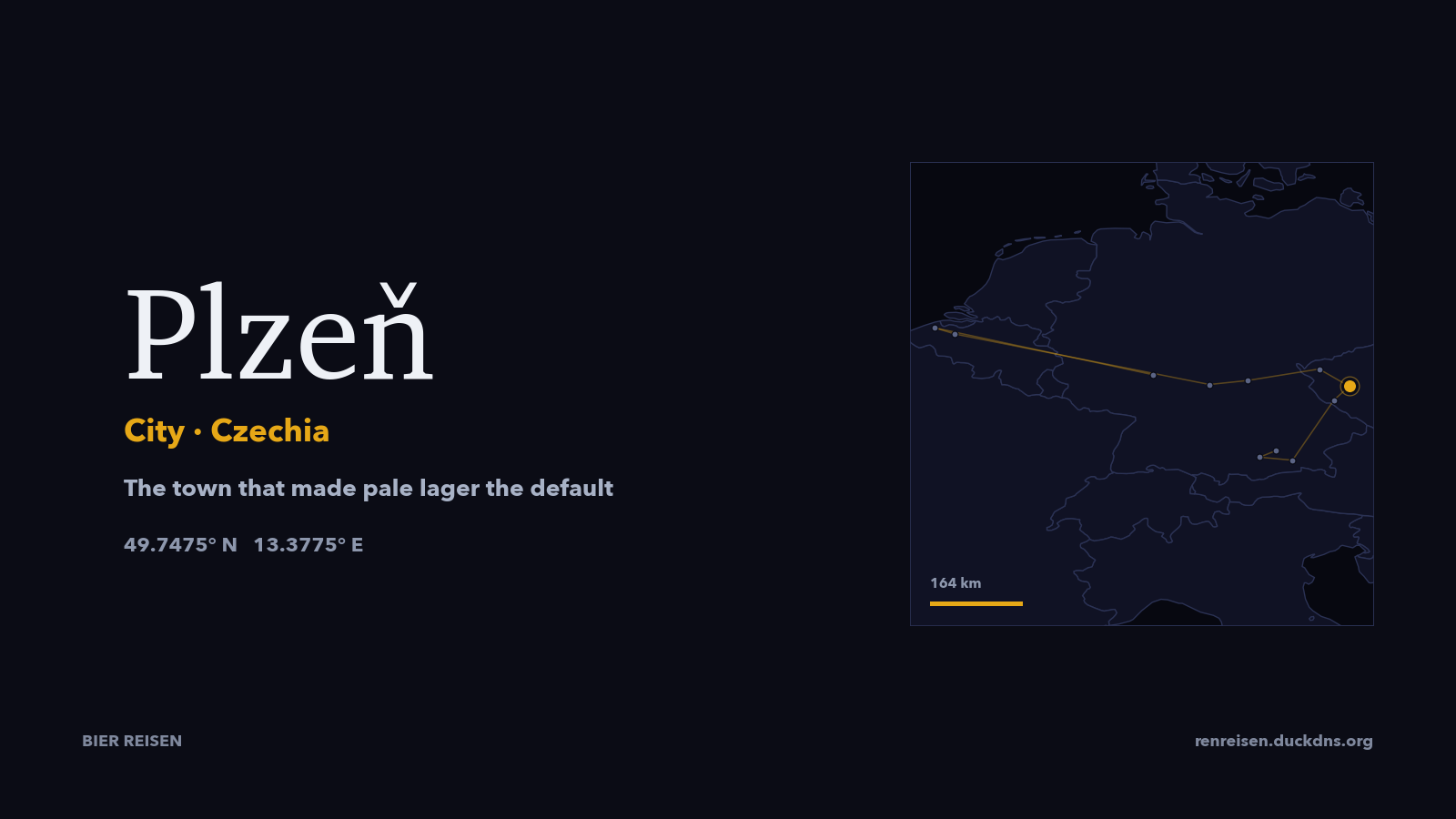
The beer that had to be invented
Until the 1830s the beer of Plzeň was top-fermented, brewed by burghers who held the brewing rights, and it did not keep. Cheaper bottom-fermented beer from Bavaria arrived by cart and sold better than the local stuff, which went sour in the barrel. In 1838 the town made its point by pouring the bad batches into the street. The next year the burghers put money into a brewery built for cold fermentation and hired a Bavarian brewer to run it.
Josef Groll came from Vilshofen an der Donau, where his father kept a brewery and had been working on bottom fermentation. He brewed the first batch at the new Burghers' Brewery on 5 October 1842, and the beer was first sold at the St Martin's market on 11 November. It was pale where other beers were brown, clear where they were cloudy, and it lasted. By the 1850s it was being copied across Bohemia, and the brewery was already trying to stop it.
The name took longer to settle. Pilsner Bier was registered as a trademark in 1859, which did nothing to stop other Plzeň breweries using it, and the brewery spent decades arguing about what it owned. The words Pilsner Urquell and Plzeňský Prazdroj, both meaning original source, were registered in 1898 and are the names that stuck. The beer is brewed in one yard again, after a spell of licensed brewing in Poland and Russia between 2002 and 2017.
The square and the underground
Náměstí Republiky is the centre, and the Cathedral of St Bartholomew stands over it with a tower of 102.26 metres, the tallest church tower in the country. There are nearly 300 steps to the gallery. Beside it is the Great Synagogue, finished in 1893 and one of the largest in Europe; the city council made the architect lower its towers by twenty metres so they would not compete with the cathedral.
Under the streets is the other city: nearly twenty kilometres of passages, cellars and wells, dug from the end of the thirteenth century and up to three floors deep in places. The tour covers about 800 metres and starts in the brewing house that holds the Brewery Museum on Veleslavínova. It is 12°C down there and they hand you a helmet. At the end you get a voucher for a beer in one of the brewery pubs.
The Brewery Museum has occupied the fifteenth-century brewing-rights house since 1958, and it is the place to understand what a brewing right was: a licence to brew a fixed quantity, attached to a house and traded like property. Plzeň's beer was made in dozens of these houses before the burghers pooled them into one brewery. The museum keeps the malthouse, the cellars and a case of beer curiosities, including the smallest jug in the world, according to the label.
Where to drink it
The brewery is a fifteen-minute walk from the square, across the river and through a gate whose emblem ended up on a Czech gold coin. Inside the forecourt, Na Spilce fills the old fermentation cellars: 550 places, vaulted brick, and unfiltered Pilsner Urquell that does not leave the building. It is one of the largest pubs in the country and it fills up, so book a table or arrive early.
Na Parkánu, beside the Brewery Museum, has been pouring since 1966 and is the place for a quiet half-litre and a plate of sausages. U Salzmannů on Pražská has been a pub since 1637 and claims the title of oldest in town. Both keep Pilsner Urquell properly, which in Czechia means a tank or a clean line rather than a bottle.
For something else, Purkmistr in Černice is a brewery, hotel and beer spa in a farmyard on the southern edge, and Pivovar Raven in the north of the city brews ales rather than lager. Neither is in the centre, and both are worth the trip. Gambrinus, brewed here since 1869, is the everyday beer: lighter than Prazdroj, cheaper, and in most pubs the default pour.