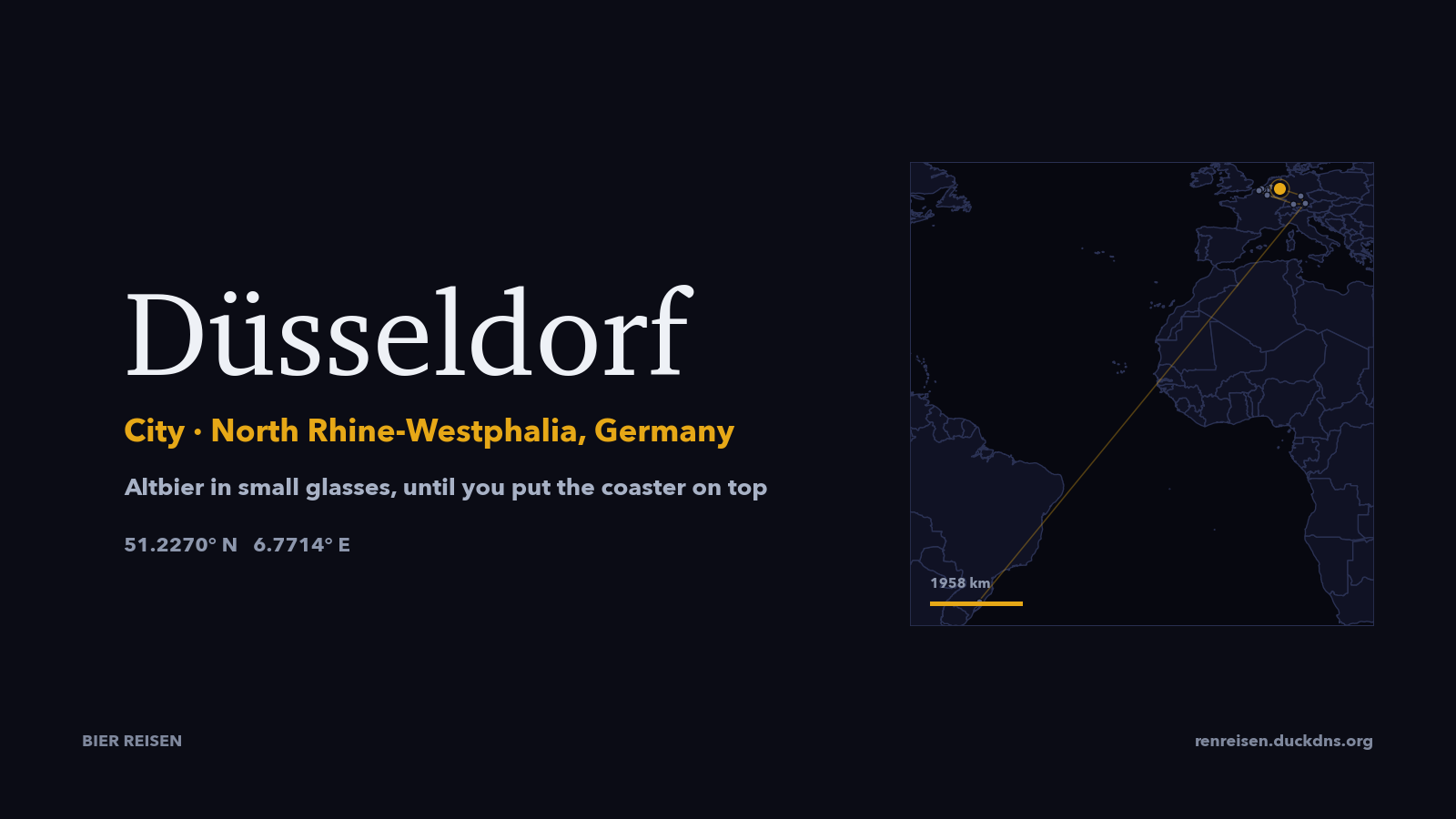
Half a square kilometre
The Altstadt runs from the Heinrich-Heine-Allee to the Rhine, with the Burgplatz and its Schlossturm at one corner and St. Lambertus behind it. By day it is a shopping district; after six it is a drinking one; in summer it is both at once, when the tables spread along the Rheinuferpromenade and the streets behind the church fill up. The whole quarter is pedestrian, and the Rhine is three minutes away whichever way you turn.
Arriving is easy. The main station is two U-Bahn stops from Heinrich-Heine-Allee, and from there the old town begins across the street. The Königsallee, the wide shopping boulevard with the water in the middle, borders it to the south; the MedienHafen with its Gehry buildings is twenty minutes further along the river. Every U-Bahn line into the centre stops at Heinrich-Heine-Allee, so the route needs no thought.
Six house breweries still brew in the city: Schumacher, Uerige, Füchschen, Schlüssel, Kürzer and Belsen. Five of them stand within a few minutes of each other in the Altstadt, which makes a crawl possible without a plan, a map or a taxi. That concentration is the reason the place works as a beer destination. A crawl of all five is a long afternoon rather than an evening, and the order matters less than the pace.
How Altbier works
Alt is top-fermented and then stored cold. The name means old, in the sense of the old way of brewing, as against the pale lagers that arrived from Bavaria and Bohemia in the nineteenth century. The colour runs from copper to brown, the bitterness is firm, and the strength is usually around 4.7%. Düsseldorf has brewed since at least 873, when the archbishop of Cologne granted the right to the Gerresheim monastery. It does not travel well, which is why almost all of it is drunk within the region.
It arrives in a small glass, usually 0.2 litres. The Köbes — the waiter, named after the many Jakobs who once did the job — carries a tray of them and puts a stroke on your coaster for each one. When a glass is empty, another appears without being ordered. To stop the supply, put the coaster on the glass. The glasses are thin and small enough to finish before the beer warms, which is the whole argument for the size.
It is not a system for a long conversation over a full glass. It is a system for cold beer: small measures, fresh from the tap, replaced often. During carnival the whole Altstadt runs on it, and on Rose Monday the Uerige shuts rather than deal with the consequences. The rest of the year the pace is calmer, but the mechanism is the same. Outside carnival the mechanism runs from lunchtime, and the afternoon regulars are gentler than the evening ones.
Beyond the Altbier mile
The Altstadt is not only breweries. Bolkerstraße is the loudest street, Berger Straße the one with the Uerige, and the lanes behind St. Lambertus are quieter. The Rathaus and the Jan Wellem statue are worth a look between bars, and the Rhine promenade is where everyone ends up, with the Oberkassel bank across the water and the bridge lights coming on. The promenade is stepped, and on a clear evening the far bank looks closer than it is.
Food in the breweries is Rhineland cooking. Halve Hahn is a rye roll with cheese, mustard and onion — no chicken, despite the name. Himmel un Ääd is black pudding with apple and mashed potato. Sauerbraten comes with raisin sauce. It is plain food built to sit under beer, and it does its job without asking for attention. Portions are large and the menus are short, which is the correct arrangement for food like this.
From mid-November to 30 December the Christmas market spreads through the centre, with a wheel on the Burgplatz and stalls along the Flinger Straße. The rest of the year the city lives off trade fairs: when a big one is on, the hotels go first and the Altstadt fills early. Book before you decide to come. Room rates follow the fair calendar, so a cheap weekend usually means nothing is on.