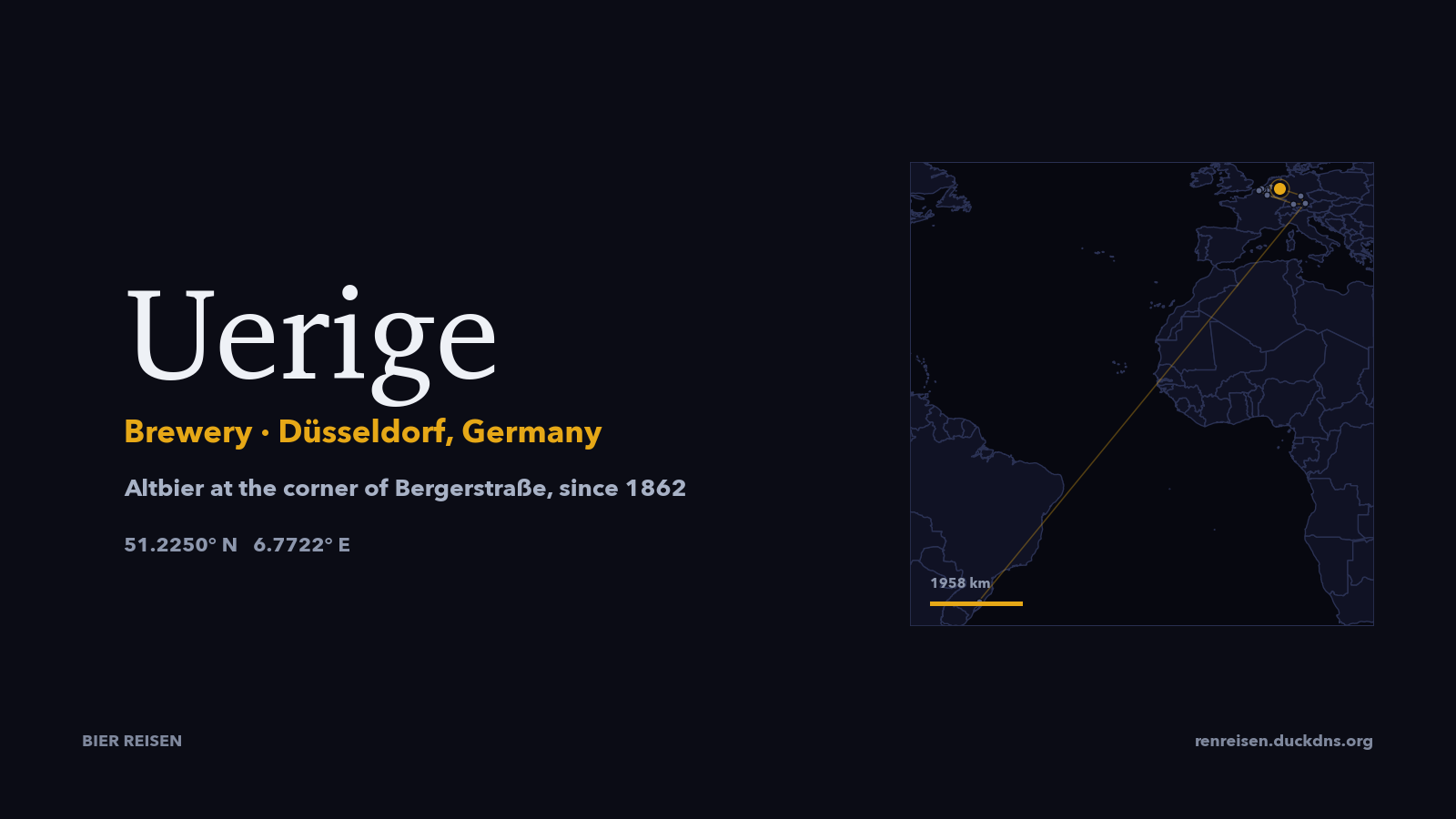
The grumpy Wilhelm
The building had several names before it had a brewery: Heidelberger Fass, then Bergischer Hof, then Berliner Hof. In 1862 the widow Bender sold it to Wilhelm Cürten, a landlord and brewer, who put the brewhouse in the cellar and the taps on the ground floor. He was known for his temper. In Düsseldorf dialect, uerig means grumpy, and the nickname stayed with the house. The brewery's own history dates the conversion to 4 January 1862, the day the deed was signed.
The sign over the entrance still says Heidelberger Fass. Cürten died in 1886, his son Max in 1902, and the brewery passed through several hands before Rudolf Arnold took it on in 1937. Bombs destroyed the front of the house in 1943 and burned the brewery out in 1944. Arnold cleared the site with his waiters and brewers and reopened in 1949. What stands today is largely the post-war building, which is why the rooms are plainer than the façade suggests.
The Schnitzler family took over in 1976, and Michael Schnitzler has run it since 1999. The brewery grew into the neighbouring houses on Rheinstraße and added a distillery in 2008. It remains one of the last independent breweries in the city, and it sells almost nothing outside the region — a deliberate choice, not a shortage. Its slogan is dat leckere Dröppke — the tasty little drop — which is dialect for exactly what it says.
The beer
Uerige Alt is 4.7%, brewed from barley, caramel and roasted malt, with whole-cone hops and the house yeast. The brewery claims the highest bitter content of any German beer, which sounds like advertising until you taste it: the bitterness is dry and long, and the malt underneath is sweeter than the colour suggests. The malt bill is short and the hopping is not, which is the opposite of most German lagers.
The beer is amber rather than brown, which makes it pale by the standards of the city. It is served unfiltered from the tap and drunk young. Alongside it the house makes a Sticke at 6%, brewed twice a year and tapped on the third Tuesday of January and October, and a Doppelsticke at 8.5% that began as an export beer for the United States. The Sticke is the same beer brewed stronger, not a different recipe, which is why it tastes familiar.
The Sticke days are the ones to plan around. The beer is stronger, the room is fuller, and the supply runs out. The rest of the year the ordinary Alt is the point: a beer built to be drunk in small glasses across a long evening, not admired in one. The house also makes an alcohol-free version, which is better than it needs to be. The alcohol-free version, by contrast, is available all year.
The room
Inside, the rooms are narrow and wood-panelled, with long tables and no music. The copper pans in the brewhouse are cladding over stainless steel now, and since 2023 the beer comes from the tanks through a pipe to a cask that is a shell rather than a cask. The beer itself is still brewed on the premises, which is what the sign promises. The 2008 annex was built so guests could watch the brewing, which is the closest the place gets to a museum.
The Köbes carry trays of 0.2-litre glasses, mark a stroke on your coaster for each one, and write the food on the same piece of cardboard. They add it up in their heads. You pay at the end, at the table, and nobody asks you to move along. The system works because everyone in the room knows it. Nothing goes into a till until the end, so the coaster is the only record of the evening.
The kitchen is plain and follows the day: lentil soup on Monday, Königsberg meatballs with beetroot and caper sauce on Tuesday, potato soup with a bockwurst on Wednesday, goulash on Thursday, cabbage roulade on Friday, pea soup on Saturday, goulash again on Sunday. The knuckle of pork has to be ordered ahead. The pea soup is the one locals mention. The menu is short because the kitchen cooks one thing properly each day, which is a reasonable arrangement.