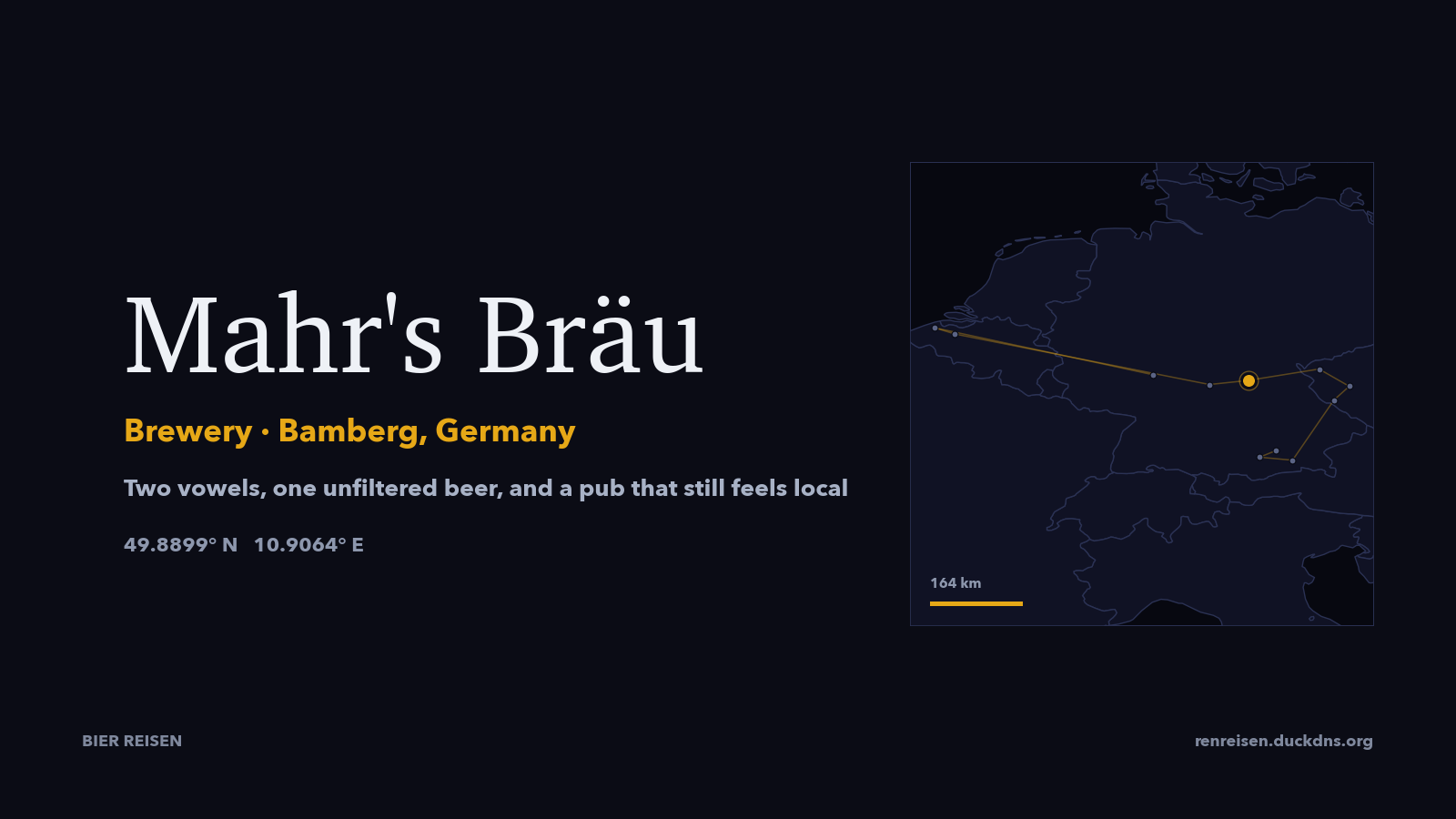
Two vowels
Ungespundet means unspunded: the barrel is left open while the beer matures, so the carbon dioxide from fermentation escapes instead of being trapped in the beer. The result is flat, soft and slightly tart, and it never clears like a filtered lager — the aU is hazy amber with a loose white head. The style survives in Bamberg and the villages around it, and hardly anywhere else.
Mahr's version is about 12.7% original wort and 5.2%, bittered with Hallertauer Perle, and served in a stoneware mug at seven to nine degrees. It is a session beer in the literal sense: little gas, moderate alcohol, long afternoon. The brewery calls it “halt a U” — just a U — and the ordering ritual is half the pleasure. Nobody says the whole word at the bar.
The other advantage, according to the town's own beer writing, is that after two or three mugs “a U” is still pronounceable. That sums up what the beer is for. The brewery also makes a Pils, a Helles, a dark lager called E.T.A., a bottle-fermented wheat beer, and two bocks at the start of winter. In a town with eleven breweries, it is the one beer locals order without looking at a card.
The Wunderburg
Mahr's is not in the old town. It sits in the Wunderburg, the working neighbourhood east of the centre, opposite Keesmann's brewery, in a courtyard where beer has been brewed since at least 1670. The Michels arrived in 1895, when Johann Michel Jr bought the estate at Wunderburg 10 together with the cellars cut into the sandstone of the Stephansberg. The pub opens straight off the yard.
The brick brewhouse dates from 1908, when the old building — known as “Zum Brenner” — was pulled down and rebuilt with a 32-metre chimney; it is now a protected monument. The name is older than the family: Karl Mahr bought the estate in 1840, and the Michels arrived in 1895. In 1913 the brewery went bankrupt and was auctioned; Elise Michel, Johann's third wife, bought it back. Stephan Michel has been sole managing director since 2016.
One beer carries a date. The E.T.A. is a dark lager first brewed in 2008, the city's E.T.A. Hoffmann anniversary year, for the writer who worked in Bamberg's theatre. It was meant to be a one-off. It is now a permanent beer at 13.5% original wort and 5.0%, with a little chocolate and a dry finish, and it has stayed on the list ever since. The malt comes from the Bamberg malting house, as it does for the rest of the range.
The taproom
Inside, the pub is a run of low rooms with dark beams, a tiled stove in the corner and tables that seat whoever arrives. The beer garden behind is small, fenced and shaded, and in summer it takes most of the custom. Food is Franconian and generous: Fleischpflanzerl, Biergulasch, goose in season, Brotzeit at any hour. It is a brewery with a pub attached, not a restaurant with a brewery at the back, and the pace shows it.
The scale is domestic, and the address is still a house rather than a plant: a gate, a yard, a pub, and the brewhouse behind it. Mahr's is a neighbourhood pub that happens to brew, which is why the room feels less visited than Schlenkerla's and why the corner seats still belong to people who walked in without a map. The garden was renovated and now pours more of the range than the taproom does.