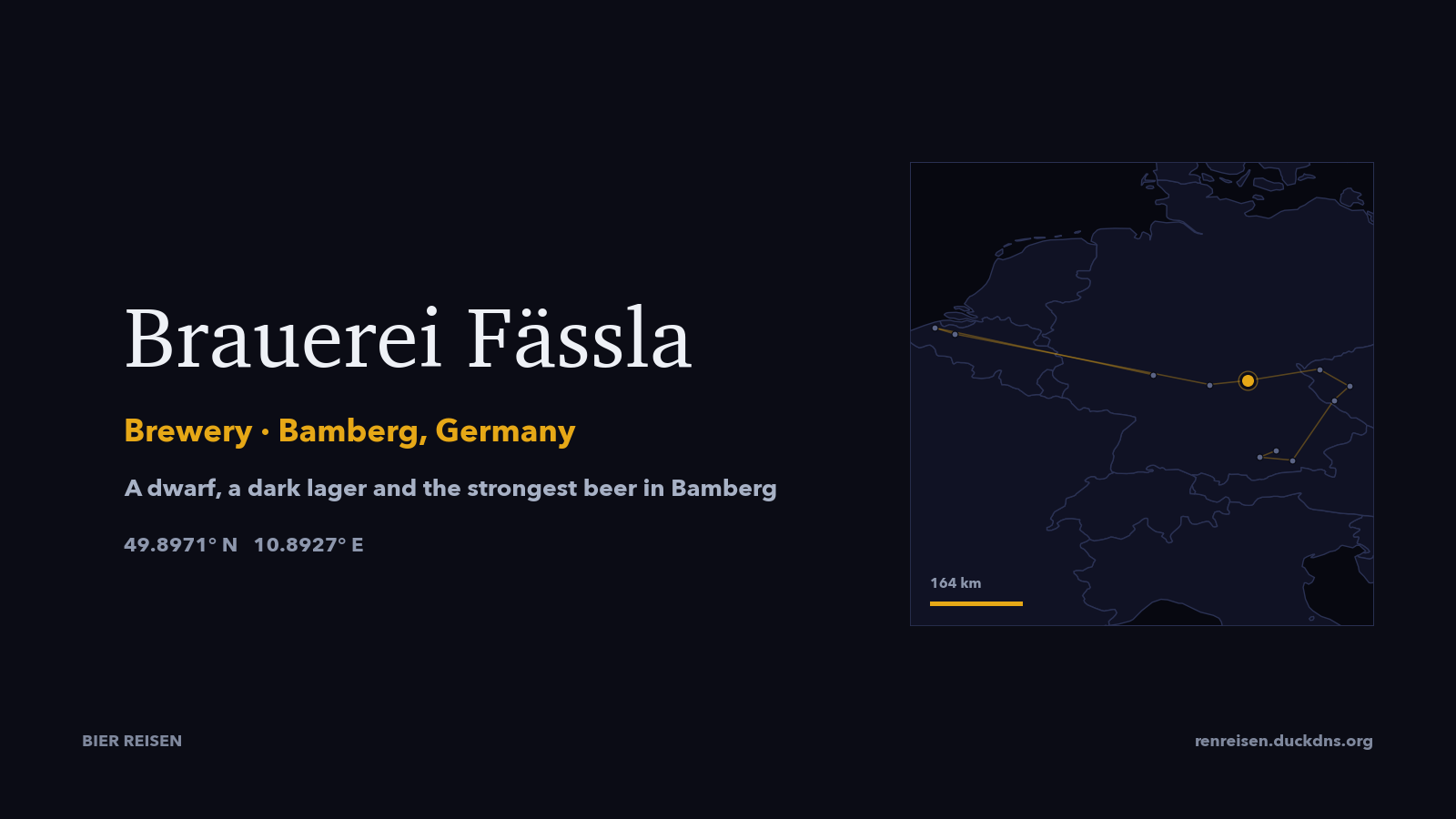
The dwarf and the dark beer
The dwarf is on every label, rolling a barrel bigger than he is. The beer named after him is the reason to come: Zwergla is a dark lager, almost mahogany in the glass, 13.5% original wort and 6.0%, soft and malty with the hop note kept low. It tastes better in the second mug than the first, which is true of most dark lagers and worth knowing before ordering a small one.
Fässla is a diminutive of Fass, a barrel, so the name and the crest say the same thing twice. Bambergers recognise the beer by the dwarf before they read the word, which is the test of a good crest. He wears green and red, rolls a brown barrel and looks busy — which suits a brewery better than a coat of arms with lions on it.
The range is six beers and none of them is a novelty. A lager at 5.5%, a gold pils at the same strength, a helles at 5.4%, a bottle-fermented wheat beer at 5.0%, the Zwergla at 6.0%, and the bock in autumn. For a brewery of forty thousand hectolitres — the second largest in Bamberg after Kaiserdom — that is a short list.
1649, the year after the war
The brewery was founded in 1649, a year after the Thirty Years' War ended, by Hanß Lauer, a brewer and cooper, in the corner house at the Gang zum Heiligen Grab. The house is older than the brewery: it appears in the oldest rent books of the St. Gangolf foundation in the fourteenth century and was leased on St Vitus's Day 1398 to Conrad Kauffmann and his wife Kunigund for a pound of money in local currency.
The site changed hands many times before the Kalb family took it on 1 October 1986. Roland and Lukas Kalb run it now, with six beers in the range and a kitchen that cooks Franconian food without decoration. There are guest rooms upstairs and the station is five minutes away, which makes this one of the few beds in Bamberg directly above the bar.
Bambergator
Every autumn the brewery makes Bambergator, a doppelbock at 21% original wort and 8.5%. It is dark brown, heavy and round, and the brewery calls it the strongest beer in Bamberg — the numbers support the sentence. It is brewed in September, tapped at the October Bockbieranstich, and gone by spring. Ask for it in July and you get a sympathetic shake of the head.
The rest is ordinary in the best sense: a lager at 5.5%, a gold pils at the same strength, a helles at 5.4%, a bottle-fermented wheat beer at 5.0%. Nothing is extreme except the bock. That is the point of a house like this: the everyday beer pays the bills, and the strong one is the annual event. Between the two sits the actual character of the brewery, a dark lager you can drink all evening.