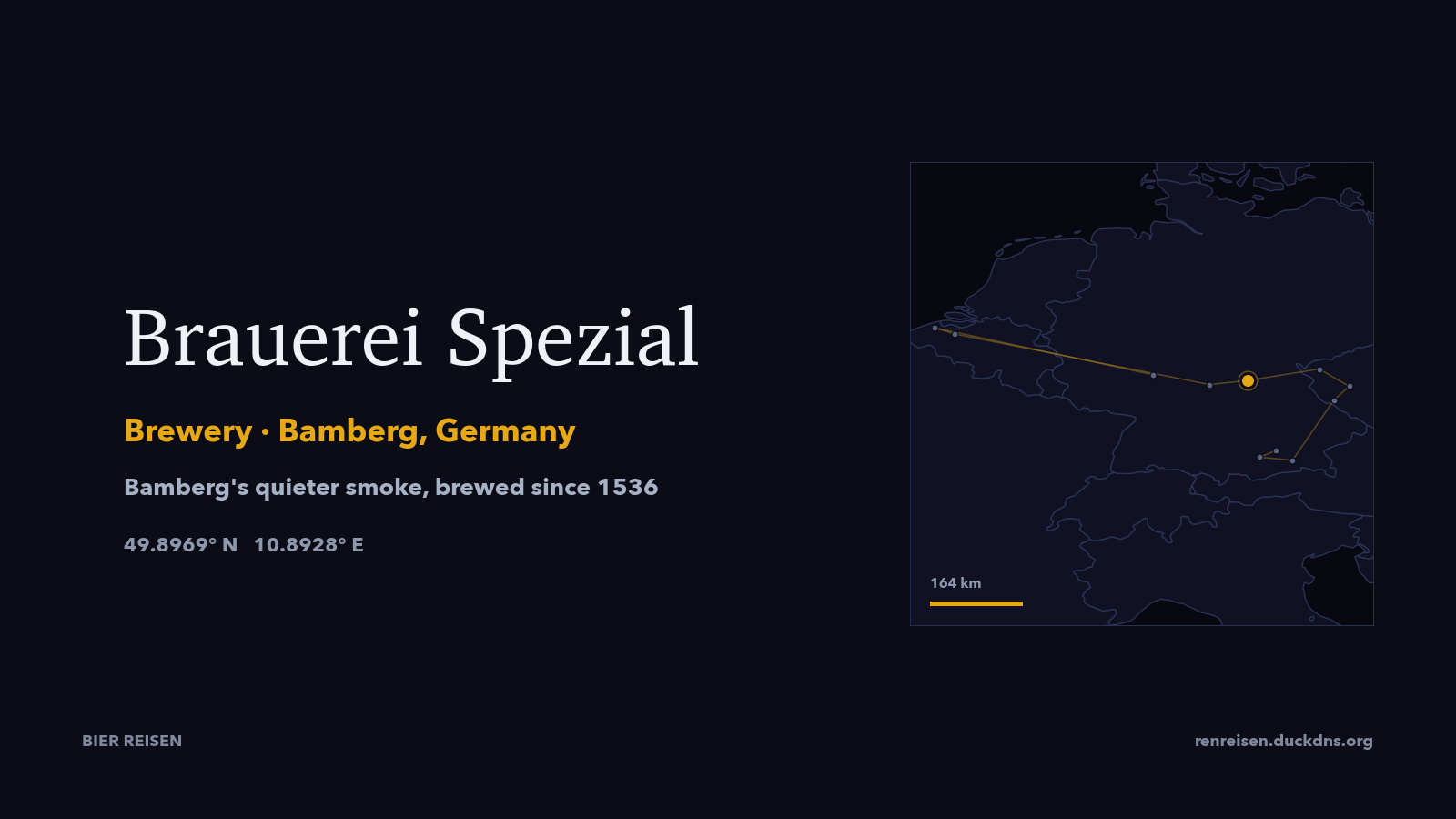
Smoke, turned down
The malt is made in the yard behind the pub. Barley from organic farms in Upper Franconia is steeped, germinated and then dried for about twenty-four hours over an open fire of split beechwood, fed by hand. Christian Merz, who runs the brewery, is often there at night to watch the kiln. The slow drying is what puts smoke into the malt, and the malt is what gives the beer its softer, rounder smoke than the one a few minutes' walk away.
Only two breweries in Germany still malt their own this way: Spezial and Schlenkerla. Both are in Bamberg, which is either a coincidence of history or a sign of how stubborn the city is about beer. Slow Food put both on its Ark of Taste list for the method. The brewery makes around six thousand hectolitres a year and does not send it far: you will not find the beer in a drinks market much beyond fifteen kilometres from the cathedral.
The Lager is the way in: amber, around 4.9% and 12.3% original wort, with a smoke that arrives after the malt rather than over it. The Märzen is darker and firmer in the body and takes a bigger mouthful. The wheat beer absorbs the smoke in a way that sounds wrong at first and then tastes like bread toasted over a fire. Order the first one small and the second one large.
The beer without smoke
Spezial also brews one beer with no smoked malt at all. The Ungespundetes is pale, unfiltered and lagered without a spunding valve, so the carbon dioxide escapes instead of dissolving into the beer. What arrives is almost still, cloudy and dry, with a hop bitterness that turns up late. It has been made since 2006, the hops come from contracted farms in Bavaria, and it stays in the house: shops do not get it.
Order it as a Seidla, the Franconian half-litre, and eat something salty with it. Without gas the beer tastes warmer and grainier than a normal lager, closer to the cellar than to the tap. Regulars use it as a pause between smoked beers — a sensible way to spend an afternoon in a town where every second beer tastes of a fireplace. Nobody hurries you out of the seat, either.
In winter the dark Wirtsstube does the work; in summer it is the courtyard behind the house, where the beer comes out of the same tap and the tables sit against the wall. The kitchen is Franconian and unhurried, Sundays are for roast meat with Klöße, and the cycle path along the Rhine–Main–Danube canal passes less than fifty metres from the door, which is why the bike racks are full at lunch.
The house and the hill
Apart from a few technical fittings, the property is regarded as a textbook example of a sixteenth-century brewery, on the old trade road from Prague to Frankfurt. The name is less clear. It first appears attached to Niklas Delscher, described in a document as “Spicial genannt, eyn Bräuer und auch Büttner” — a brewer and a cooper, called Spezial. Whether that was a nickname or a trade description, the house kept it.
The Merz family has owned it since October 1898, and both sons trained as brewers. The brewery has stayed small on purpose: around six thousand hectolitres, one brewhouse, one malting floor, and a delivery radius short enough that the beer is still fresh when it reaches the table. The Bock is the event of the winter: 16.9% original wort, 7.1%, brewed in summer, tapped at the start of November and poured until the barrel runs out.
Up on the Stephansberg the brewery keeps its Keller: a cellar bought in 1830 to cool the beer, an ice gallows on the site that was in use into the 1960s, and a garden above it that serves the same beer with a view over the roofs. On a summer evening the garden is the better seat, and the climb is short enough to justify a second round before walking back down.