Why it tastes of smoke
Before indirect kilning arrived in the nineteenth century, every brewery dried its malt over an open fire. The smoke went into the grain, and the grain went into the beer. Most of Europe replaced that method with hot-air kilns and forgot the flavour. Bamberg did not: the malt for Schlenkerla is still dried over beechwood logs, which is why the beer smells of a cold fireplace and tastes, on the first sip, like bacon and rye bread.
The first glass is the difficult one. By the third, the smoke has stopped being a flavour and become the frame everything else sits in — the malt sweetness, the dry finish, the way it cuts through a plate of smoked ham.
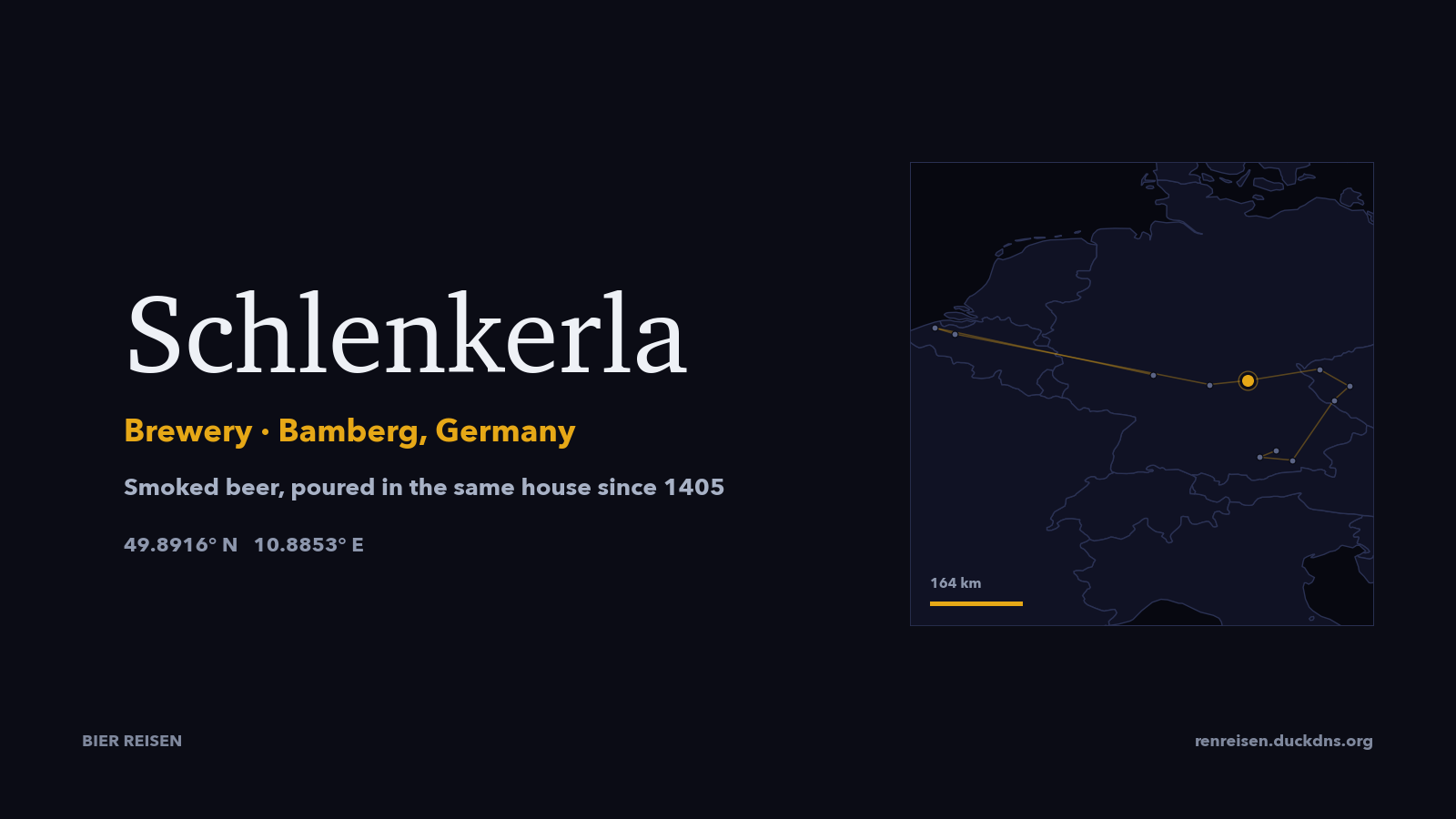
The name is younger than the beer. Schlenkerla comes from schlenkern, to sway, and only stuck at the end of the nineteenth century — a nickname for the house, or for the walk home. The building is the older story: Dominikanerstraße 6, the house zum Blauen Löwen, with a line of owners documented since 1405, in the old Dominican quarter beside the church.
Inside the tavern
The room is dark wood, low ceilings and long tables shared with whoever sits down. There is no music and no television. The beer is tapped by gravity straight from an oakwood cask behind the bar, arrives in stoneware mugs, and the menu is Franconian cooking without pretension: pork shoulder, sausages, sauerkraut, a slice of bread with lard.
It is a working tavern, not a museum. Locals stand at the bar for a quick one on the way home; visitors linger. Both are welcome, and nobody rushes you out.
The house pours more than the famous Märzen: a smoked wheat beer, an Urbock, an oak-smoked Doppelbock, a cherrywood-smoked red lager, an alder-smoked black lager, and — the one worth planning a trip around — the Fastenbier, unfiltered at around 5.9%, on tap only between Ash Wednesday and Easter.
One date belongs in any beer calendar: 23 July, Smokebeer Preservation Day, when the brewery taps special Märzen editions — unfiltered, and a pale one — that exist for that week only.
The building itself is part of the argument. The tavern sits in the old Dominican quarter, a few steps from the church, in a house that has been selling beer since the fifteenth century — one of the oldest continuously operating brewery taverns in the world.