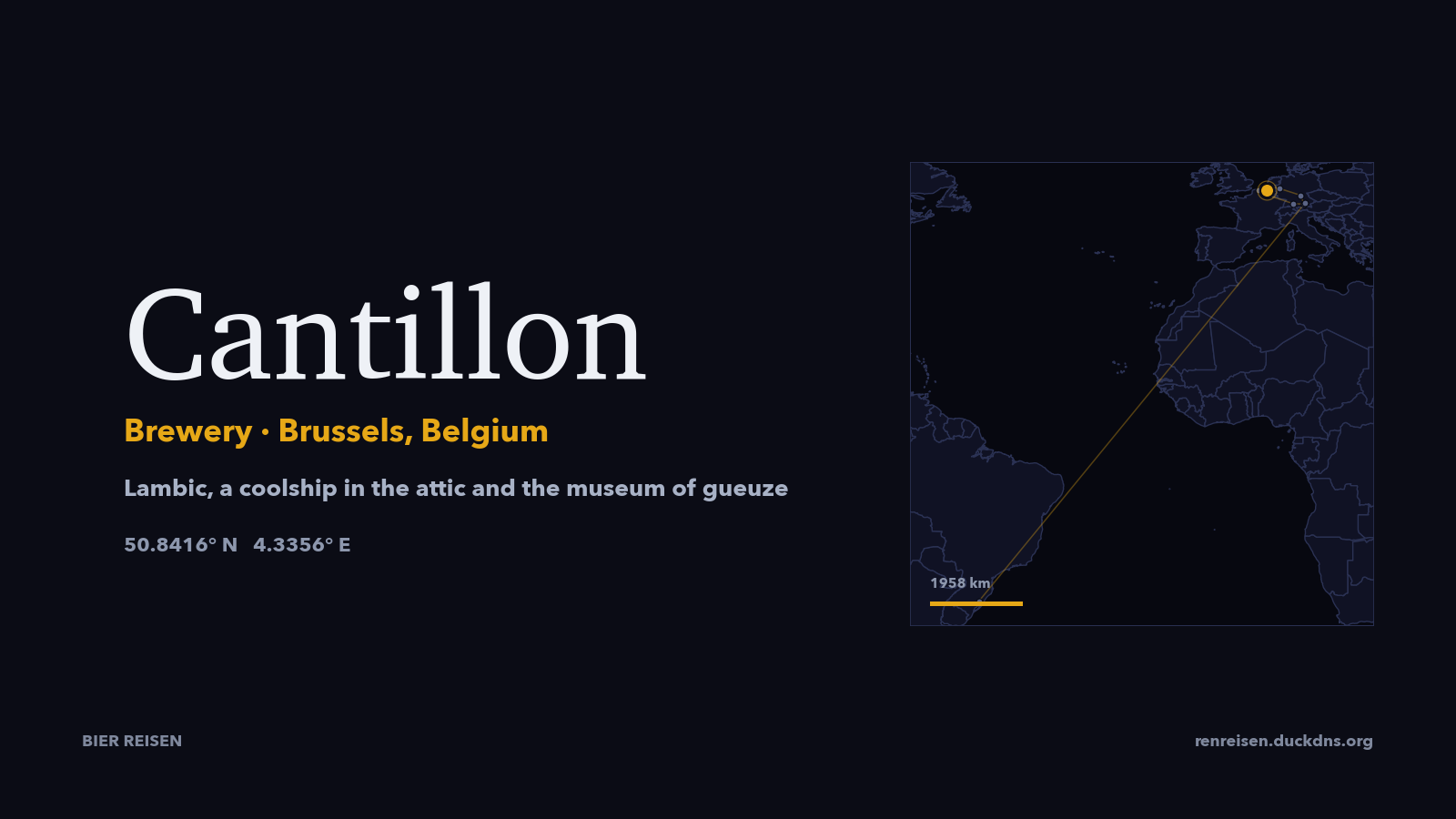
Spontaneous fermentation
Lambic is not fermented with a chosen yeast. The wort is pumped to the coolship in the attic, left overnight under louvred windows, and inoculated by whatever is in the Brussels air. It then goes into oak barrels, some of them a century old, and ferments slowly for one to three years. Nothing is added; the beer waits, and the blender decides. The air does the work that a yeast lab does elsewhere.
Gueuze is a blend of young and old lambic, bottled and refermented, which is why it sparkles and tastes of cider, lemon peel and cellar. Kriek is lambic with sour cherries, Rosé de Gambrinus with raspberries, Fou' Foune with apricots. The fruit is real, the quantities are large, and nothing is back-sweetened to make it easier. The blend decides whether it works.
Cantillon has been organic since 1999, which matters less for the taste than for the fields. The brewery's output is counted in hundreds of thousands of bottles a year, not millions, even after new maturation space. It is sold at the door and through a small network of bars and importers who know what they are doing. That is still a small brewery by any measure.
The museum that saved the brewery
By the 1970s lambic was considered old-fashioned and Cantillon was close to closing. Jean-Pierre Van Roy founded the Brussels Museum of the Gueuze in 1978 as a way to keep the doors open, with visits, tastings and a narrative. The museum did not rescue a ruin for tourists; it rescued a working brewery by letting people walk through it. It began as a survival plan, not a tribute.
The visit is self-guided from Monday to Friday except Wednesday, and guided on Saturdays. It takes about an hour and ends with three samples: lambic, gueuze and a fruit beer. You walk past the mash tun, the coolship, the barrels and the bottling line, in a building that is still producing while you look at it. The route is short, and the barrels are the best part.
The room is cold, damp and smells of wood and fermentation. There is no multimedia, no interactive display, no shop designed by a consultancy. The shop sells bottles at prices lower than in the city's beer bars, which is the best argument for going to Anderlecht rather than drinking lambic in the centre. Buying a bottle there is the simplest way to support the place.
Visiting
Cantillon is at Rue Gheude 56, in Anderlecht, fifteen minutes on foot from Brussels-Midi. The neighbourhood is not pretty: a wholesale street, a railway viaduct, a few bakeries, and the smell of the canal on a warm day. That is part of the point. The brewery is where it always was, not where a visitor would put it. There is no sign worth photographing.
Opening hours are 10 to 16, Monday, Tuesday, Thursday and Friday, with the shop open until 17. Saturday is guided tours only, booked online, and the brewery is closed on Wednesday, Sunday and public holidays. Brewing runs from about October to April; if you want to see the coolship in use, come in winter. The ticket desk closes at 16.
Do not expect a brewpub. There is no kitchen, no tables, no lunch. The tasting is standing up, at the end, and the pour is generous. Eat before or after in the Marolles or at Saint-Guidon, and give yourself time: the visit is short, but the barrels reward a slow walk. A glass of gueuze on an empty stomach is a mistake.