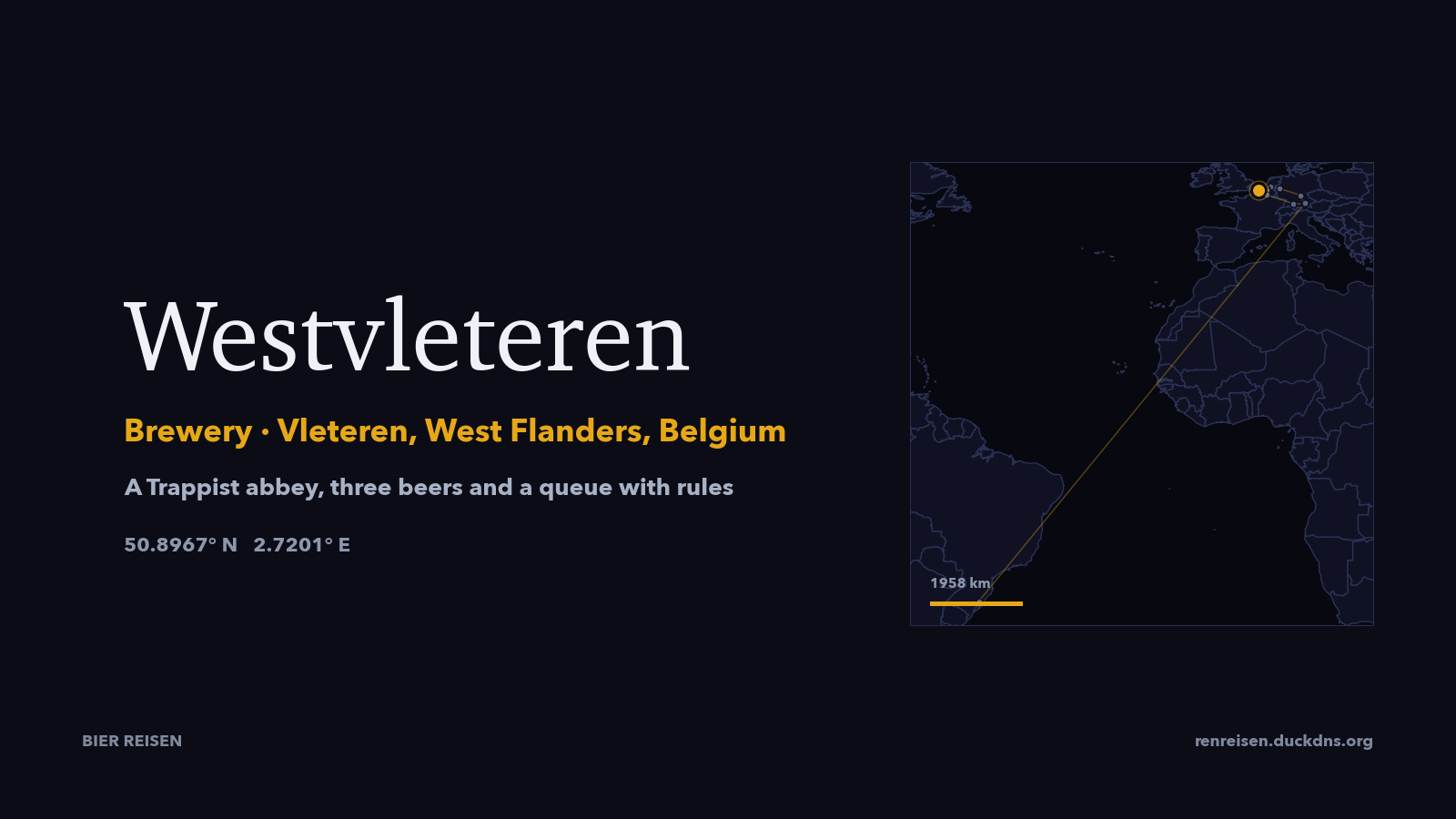
The abbey behind the wall
The monks of Saint Sixtus came from France in 1831, bought a farm and a patch of heath near Vleteren, and began brewing in 1838 to support themselves. The abbey became a Trappist monastery in the full sense in 1871. The brewery is small on purpose: three beers, brewed to fund the community and the charities it supports, not to fill a market.
There are no tours, no visitor centre inside the walls, and no brewery shop in the ordinary sense. The church is open to visitors, and the abbey runs a guesthouse for retreats, but the working parts of the abbey are closed. People arrive expecting a destination and find a religious house, which is exactly what it is. The shop and café are the only exceptions.
The landscape is part of the visit: flat fields, ditches, a few farms, and the hop country around Poperinge beginning ten kilometres west. Ypres is half an hour by car, with its cemeteries and the Last Post ceremony at the Menin Gate every evening. Most people combine the two, and the combination is the point. The roads there are straight and empty.
Three beers, one wall
The range is Blond at 5.8%, 8 at 8%, and 12 at 10.2%. The 12 was introduced in 1940 as the abbey's strongest beer and has become the one people queue for; it is a dark quadrupel, bottle-conditioned, with yeast that keeps working in the bottle. The 8 is the more drinkable of the two, and the Blond replaced the monks' table beer in 1999.
All three are brewed with water from the abbey's own well, malt, hops, sugar and the house yeast, and nothing else. The beer is not filtered or pasteurised. The recipes have changed little; the brewery has resisted the obvious move of expanding, which is why supply is smaller than demand and why the rules exist. Nothing else goes into the tank.
The reputation came from beer rating sites, which put the 12 at the top of their lists for years. The monks have been ambivalent about it: they brew to live, not to be ranked. That is not a pose. The abbey has refused to increase production enough to meet demand, and it still sells the beer at prices that make the secondary market look absurd.
Buying it, and drinking it
Since 2019 the only way to buy crates is the abbey's webshop, open to registered private individuals. Orders are limited, the calendar sets purchase and collection windows, and the rules cap how much one vehicle can take. Home delivery exists inside Belgium. Until 2019 the system was a telephone line, which collapsed under demand. The waiting room is digital now.
In de Vrede, across the road, is the abbey's café and visitor centre, and the only place authorised to serve the beer by the glass. You can also buy bottles and gift packs there, subject to availability. The menu is simple: abbey cheese, pâté with Trappist beer, rillettes, sandwiches, and the three beers. It is a café, not a tasting bar.
Go for lunch on a weekday if you want the room quiet. The café fills with cyclists and beer pilgrims at weekends, and the service is brisk rather than warm. The shop sells out; the beer in the café does not. Drink the 12 slowly, order the cheese, and leave the monks alone. Order a second 12 if you are not driving.