Koningshoeven
The abbey of Our Lady of Koningshoeven was founded in 1881 by Trappist monks from Mont des Cats in northern France, who crossed the border to escape anti-religious laws and bought three farms and a sheep pen. The name means the king's farms. Brewing began in 1884, with equipment that was modern for its time, and the income paid for the abbey buildings that still stand around the courtyard.
The Trappist label is not a style. It means the beer is brewed by monks or under their supervision, inside the monastery, and that the profits go to the community and its charitable work rather than to shareholders. La Trappe carries the seal, and was the only Dutch brewery to do so for most of its history. The rules are checked; the logo is not decorative.
The community is smaller than it was and the brewery is now run with lay staff, but the abbey still owns it and the monks still have the last word. The visitor side — tasting room, shop, tours — is professional without being a theme park. You can hear the bells from the terrace, and the fields start at the car park.
The beers
The core is Blond at 6.5%, Dubbel at 7%, Tripel at 8% and Quadrupel at 10%. The Quadrupel is the one people remember: dark, figgy, warming, and strong enough that a second glass is a decision. The Witte is the odd one out, a wheat beer with coriander and orange peel, and the only Trappist witbier brewed anywhere. It is the beer to order first on a warm day.
There is also Isid'or, an amber brewed for the abbey's 125th anniversary and named for Brother Isidorus, its first brewer, and an oak-aged Quadrupel released in batches. The water comes from five wells 200 metres deep on the abbey grounds, and the spent grain feeds the abbey's cows. The range is deliberately short; there is no experimental line. The oak-aged version is worth the extra.
The beer is bottle-conditioned except the Blond, which is filtered. The styles are Belgian in form and Dutch in tone: dry finishes, restrained sweetness, nothing exaggerated. If you know Westmalle or Rochefort, you will recognise the family and the differences. The Quadrupel travels best, which is why it is the one you see abroad. The Blond is the one for a hot afternoon.
The visit
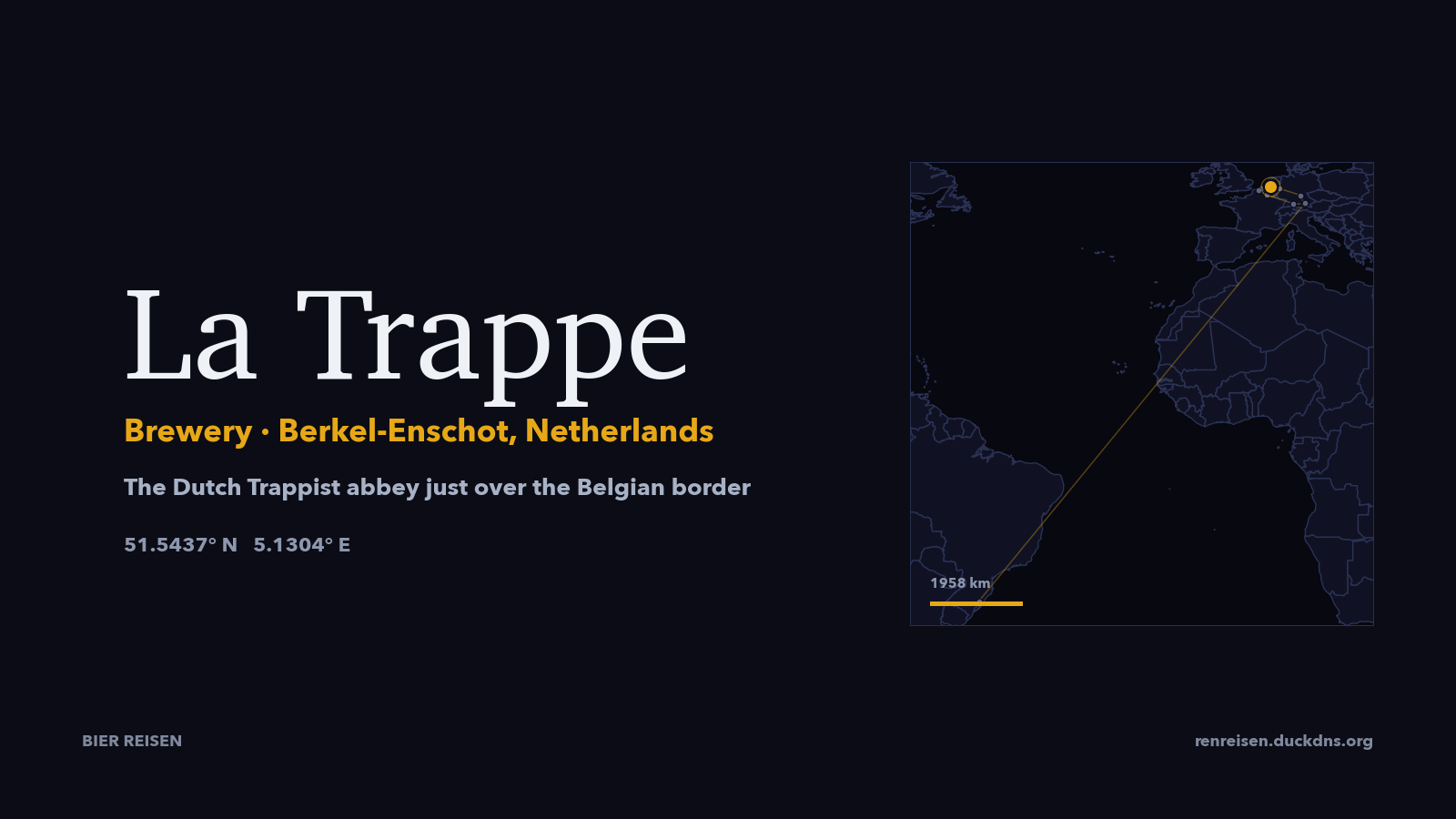
The brewery sits at Eindhovenseweg 3, on the edge of Berkel-Enschot, with the abbey behind it. The tasting room serves the full range and a short menu of soup, sandwiches and cheese; the shop sells bottles, glasses and the abbey's cheese. Tours run on set days and need booking, and they end with a tasting in the room. Booking is online.
It is an easy stop between Tilburg and Eindhoven, and a sensible one if you are driving from Germany or the Belgian border. Tilburg is ten kilometres west, Eindhoven fifteen south-east. Buses connect both, but the Sunday timetable is thin and the tasting room is at its busiest. Coming from Eindhoven is quicker by car, slower by bus. It is a plain ride through Brabant farmland.
Do not treat it as a substitute for the Belgian Trappists. It is a different country, a different scale and a different atmosphere: quieter, more modern, less pilgrimage. That is the reason to come, not a drawback. Spend an hour, drink the Quadrupel, buy cheese, and be back on the road before the afternoon traffic. The visit takes an hour, not a day.