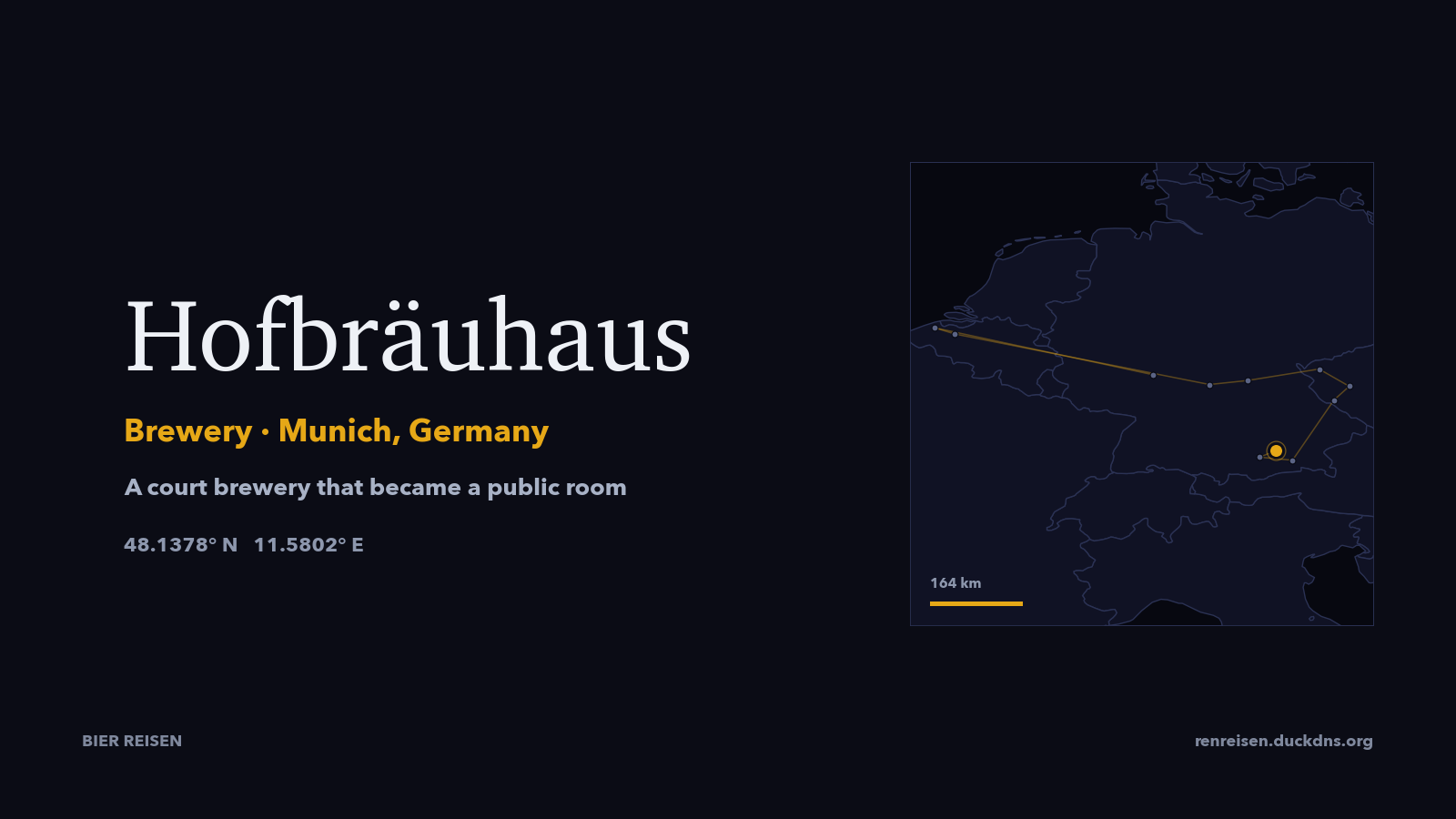
A brewery for a court
Wilhelm V ordered the building on 27 September 1589, on the site of the old chicken house beside the Alter Hof, and hired a brewmaster from the Benedictine monastery at Geisenfeld to run it. The motive was accounting. The court had been buying beer from Einbeck in Saxony, which was expensive and arrived only in spring, and a duke with a household to keep preferred to brew his own brown beer, darker and sweeter than the northern import.
In 1602 the last Count of Degenberg died and the wheat-beer privilege fell back to Maximilian I. In 1607 he built a white-beer brewhouse at the Graggenau, the site of today's building; the brown beer followed in 1608. In 1610 he allowed sales to innkeepers, and Munich taverns were obliged to pour Hofbräu whether they wanted to or not. The obligation lasted, in one form or another, until the nineteenth century.
The nineteenth century turned it into a public house. Ludwig I opened it to everyone in 1828, and in 1852 Maximilian II handed the whole thing to the Bavarian state, which still owns it. Brewing on the site stopped on 22 May 1896; the old building came down, the present one went up in 1896 and 1897, and the Schwemme reopened on 9 February 1897. The brewery moved first to Haidhausen, then to Riem in 1988.
The Schwemme
The ground-floor hall holds 1,300 people under a vaulted ceiling, and the tables are scratched with initials, dates and small declarations, some of them there since 1897. The brass band plays on a stage in the middle of the room, almost every day. The repertoire is Bavarian, the volume is high, and the room sings along to the songs it knows. There is no quiet corner. The room is the performance.
Downstairs takes no reservations. You walk in, look for a gap on a bench, ask whether it is free, and sit. The waiters carry six or eight Maß at a time and have no interest in a long conversation; nobody brings a menu unless you ask. Upstairs, the Bräustüberl and the Wappensaal can be booked, which is what Munich families do when they want the room without the crush.
The menu is short and heavy: Schweinsbraten, Haxn, Leberknödel, Käsespätzle, Sauerkraut, soups and sauces made in house. The bread comes from the house bakers and the flour from the Hofbräuhaus-Kunstmühle next door, which has been milling for the same address for centuries. Desserts come from the house confectioners: Kaiserschmarrn, apple strudel, Bavarian cream. Portions are large, the prices are city-centre prices, and the kitchen closes before the room does.
What to order
Hofbräu Original at 5.1 per cent is the default, and the beer most people mean when they say Hofbräu: a Helles with a firm malt body, 24 IBU and a dry finish. Dunkel is the darker order, softer and better suited to roast meat. Münchner Weisse covers the wheat-beer drinkers, and it is the one beer here with a direct line to the court, which held the wheat-beer monopoly for two hundred years.
Maibock appears in spring and is the oldest light bock in Munich. Oktoberfestbier arrives in autumn. The brewery itself is in Riem now, at the Hofbräuallee site, so there is no mash tun to see here; the copper you might expect belongs to the old story. This is a drinking hall with a brewery's name on it, and it makes no apology for that.
Timing matters more than seating. Before eleven the hall is half empty, the band is audible and the waiters have time. After nine it is full, the aisles are blocked and the noise is the point. Saturday afternoon is the worst of both: full and slow. Both are the same room on the same day. Decide which one you came for and arrive accordingly.