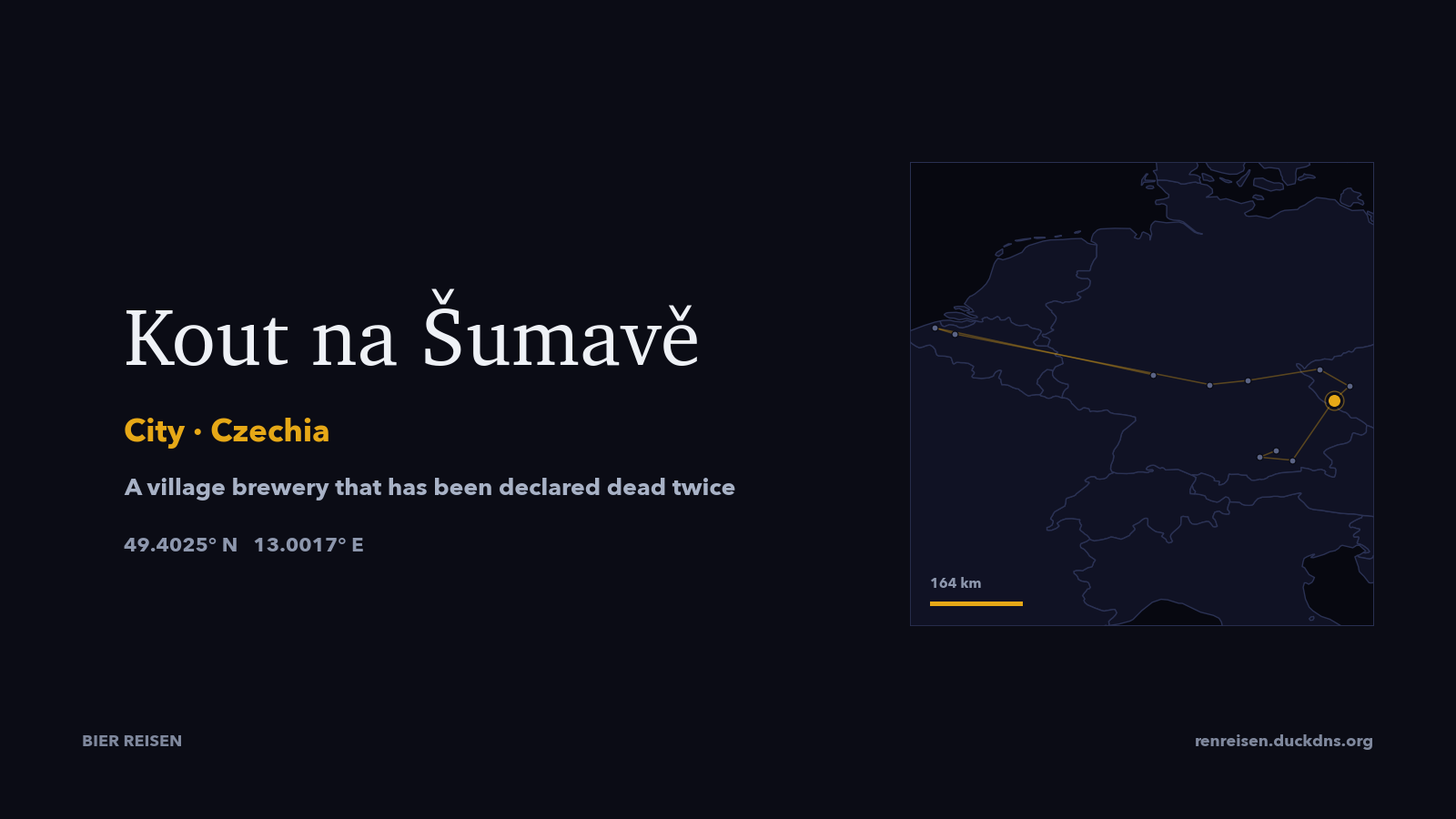
The village, and the name
The village was first written down in 1544, though it grew around an older fortress that still stands, below the church of St George. The brewery is younger than the fortress and older than almost everything else: first recorded in 1736, when the estate belonged to the Counts of Stadion, who gave the place its scale. Kout has 358 houses, a post office, a library and not much else, and the fields run out to the woods in every direction.
The name is a local joke of the kind Czech villages enjoy. Kout lies in Chodsko, on the edge of the Český les, not in the Šumava National Park; the Všerubský pass, a few kilometres west, is the natural divide between the two ranges. The village sits at 425 metres in a bowl of hills, with the spring the brewery has always used, the Stříbrný pramen, coming out of the ground nearby.
Above the village, Count Stadion built a gloriette in the first half of the nineteenth century and shaped its roof like a cardinal's hat. It commemorates the Battle of Domažlice in 1431, when Cardinal Giuliano Cesarini fled the field and lost his hat, which the Hussites carried to Prague and hung in the Týn church. The pavilion is called Klobouk, the hat, and it stands in a field north of the village with a view of the pass.
A brewery that keeps dying
The brewery burned down in 1838 and was rebuilt larger by Count Karl Friedrich Stadion-Thannhausen. In 1870 the cellars were dug under the church, which is where the beer was lagered; in 1933 the maltings, the oldest surviving part, was raised by a floor. After 1948 the brewery was nationalised, the last batch was brewed in the 1960s, and the buildings became a soft-drinks plant before closing in 1971. In 1993 the copper kettles were cut out and sold for scrap.
Ján Skala bought the ruin in 2002 and, with the brewer Bohuslav Hlavsa, started again. The first batch was brewed on 27 March 2006. The beer was unpasteurised, not dosed with carbon dioxide, made from Czech malt and Žatecký hops, and it was the 12° that made the village famous: thick, bitter, and poured in a handful of Prague pubs that took the trouble. Skala died in 2017, the brewery closed in 2019, and a court declared it bankrupt in 2020; more than 123,000 beers were poured away.
In 2025 a new owner, Aleš Pech, took over the yard and renamed it Stadioner, after the family that built it. Sales began on 28 October 2025, with beer brewed at partner breweries while the brewhouse is put back together, and plans for a restaurant and rooms. Whether the 12° comes back as it was is an open question. The village has heard promises before, and the last two decades have been hard on small breweries.
The walk, and the practical
From the brewery yard, the church is two minutes uphill and the fortress is a few steps away. The Klobouk is a twenty-minute walk north through fields, on a track that turns to mud after rain. Rýzmberk, the ruin that gave the lords their name, is a longer walk or a short drive, with a lookout tower on the rock and the whole Všerubský pass laid out below.
There is a pond, Novodvorský rybník, with a 300-year-old lime tree on the bank, and a 350-year-old oak and a maple with a girth of 530 centimetres along the lane south. The pond is where the village walks on a Sunday, and the trees are older than every brewery owner of the last century. These are the sights: trees, a hat-shaped pavilion, a ruin, a church. Nobody comes to Kout for the shopping, and the village is the better for it.
You need a car. Kdyně is three kilometres east with a supermarket and a couple of pubs; Domažlice is seven kilometres north-west with the restaurants, the museum and the Chodsko dialect on the signs. The brewery has a shop for bottles, and the yard is at number 2, at the top of the village by the church. Check the opening before you drive out: a village brewery keeps village hours.