The middle, on foot
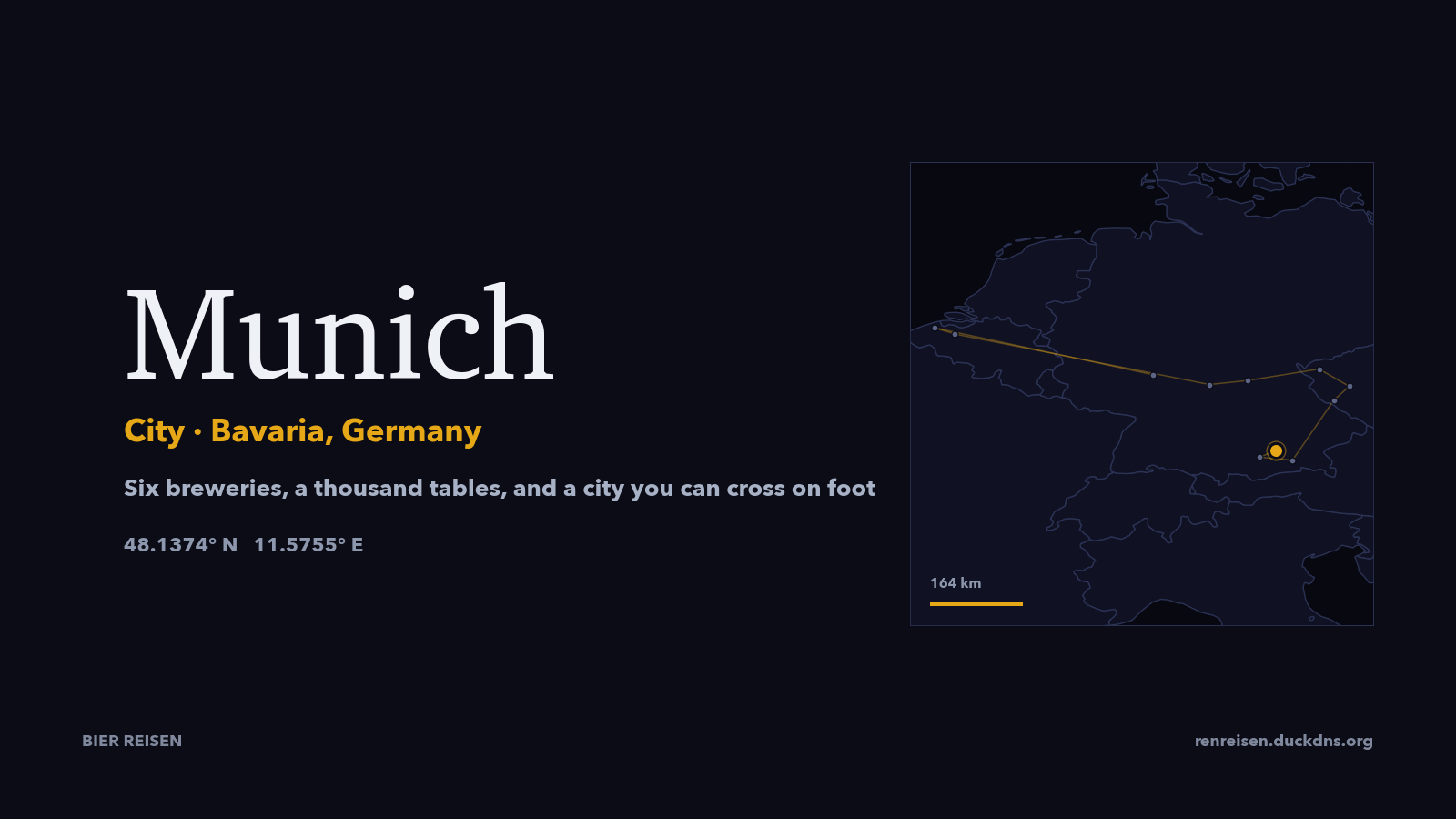
Marienplatz is the centre of gravity: the Neues Rathaus on one side, the Viktualienmarkt behind it, the U3 and U6 underneath, every S-Bahn line passing through. The market keeps a small beer garden under the maypole, with a tap that changes brewery every few months. From Marienplatz the beer geography is a ten-minute walk in any direction. Tal runs east to the Isartor, with the Schneider Bräuhaus at number 7; two minutes north lie the Platzl and the Hofbräuhaus; west along Neuhauser Straße stands the Augustiner Stammhaus.
The ring road is the honest boundary of the walkable city. Inside it you can cross from the Isar to the Hauptbahnhof in half an hour, past the market, the Tal and three brewery taps. Outside it the beer spreads into districts: the Maxvorstadt has the Augustiner-Keller and the Bräustuben beside the brewery, the Englischer Garten has the Chinesischer Turm with 7,000 seats under the chestnuts, and Giesing and Perlach have the small breweries.
The U-Bahn does the rest. U3 and U6 run north-south through Marienplatz, U1 and U2 through Sendlinger Tor and the Hauptbahnhof, U4 and U5 through Odeonsplatz and Lehel. The S-Bahn trunk line links Pasing, Hauptbahnhof, Karlsplatz, Marienplatz and Ostbahnhof, which covers most of what a visitor needs. One MVV ticket covers the U-Bahn, the S-Bahn, the tram and the bus, and the machines on the platforms take cards.
Six breweries, and the rest
Munich's beer map is still dominated by six names: Augustiner, Hacker-Pschorr, Hofbräu, Löwenbräu, Paulaner and Spaten. Only these six may pour at the Oktoberfest, a rule older than any of their current owners. Augustiner is the last one still owned in the city, the Hofbräuhaus belongs to the Free State of Bavaria, and the other four sit inside international groups.
The concentration is recent. Spaten and Löwenbräu belong to AB InBev, Paulaner and Hacker-Pschorr to the Paulaner group. What survived is a narrow range: Helles, Dunkel, Weißbier, Pils, and the strong beers of Lent and spring. Münchner Bier is a protected geographical indication, which sounds grander than it is. It means the beer was brewed here, with Munich water, and not in a plant outside the city.
The small breweries came later, mostly after 2010. Giesinger started in a garage and now has a taproom full of neighbours. Forschungsbrauerei in Perlach brews and lets its name do the science. Hopfenhäcker, ORCA and Tilmans make hop-forward beer for people who have had enough Helles. Most are an S-Bahn ride from the centre and open in the afternoon; they are worth the detour, but they are not why the city drinks.
How the gardens work
Beer gardens began as brewery cellars with chestnut trees planted over them for shade. The trees kept the gravel cool, which kept the beer cool. When an 1812 decree stopped the cellars serving food, guests began bringing their own, and the habit stuck. The Bavarian beer garden ordinance of 1999 still protects it: in a self-service area you may eat your own cold food, but the drinks must come from the house.
The furniture tells you where you are. Bare wooden tables mean self-service and your own Brotzeit; laid tables with waiters mean a served area. Sit where there is space, ask 'ist hier frei?', and expect to share. A Maß is a litre, and the glasses go back to the tray by the counter when you leave. You pay at the end, and rounding up is the tip.
The scale is hard to picture. Augustiner-Keller has 5,000 seats, the Chinesischer Turm 7,000, the Hirschgarten 8,000. They fill after work and at weekends and empty when the weather turns. In winter the gardens shut and the Wirtshaus takes over: lower ceilings, the same beer, and a menu that runs from roast pork to dumplings. The difference between the two rooms is mostly the ceiling and the noise.